Friday, March 25, 2011

Head Light Converstion


This is a cut-n-paste of a thread on bimmerforms regarding the converstion to hella h4's to which jester323 says: A much easier option could have been to simply adapt E30 ellipsoid buckets to my e21, but these turned out to be challenging to source. If you can find a pair of these, apparently it's pretty easy to slot the mounting holes and they can simply be screwed to the core support.


So I decided that it would not be an impossible task to adapt e30 euro ellipsoids to my e21 buckets, despite what I have been told by others. And no, you can not simply shave a bit off of the ellipsoid housing with a Dremmel to make them fit like I have also read.


To start, I removed the low beam buckets from the bracket that holds both buckets. this is done by simply unscrewing the the lamp adjusting knobs until the screw is completely removed, then wiggle the adjuster free from the bracket. I needed to figure out which housing belonged on which side as the beam cutoff doesn't just cut the top half of the beam off, but it also allows a slight angle up from the center of the beam pattern on one side. This helps to illuminate signs and other roadside objects better. To do this I installed an H1 bulb in one of the housings and used some alligator clips to a spare battery I had laying around and projecting a beam onto the wall of the garage to see which side aimed up a bit higher. there are three mounting tabs on the back of the housings, two on the top and one on the bottom. The mounting tab on the bottom will be on the outside. For example, this is the driver's side housing:


Wednesday, March 23, 2011

e21 Head Grills


To draw clear visual distinction within the new model series, the 320 models came with dual headlights, while the 316 and 318 had single round headlights.


The small light is NLA from Hella as far as I know. You can make the small light off a VW Golf/Cabrio (MK II) work but it is going to require some modifications as the tabs do not line up with the BMW E21 grill.

e21 Review


BMW

BMW 320 E21

1975 - 1981
Country:
Germany
Engine:
Inline 4 SOHC
Capacity:
1991 cc
Power:
109 bhp at 5800 rpm
Transmission:
4 spd. man / 3 spd. auto
Top Speed:
106 mph
Number Built:
n/a
Collectability:
2 star

Although the BMW company's reputation was built on its large saloon and sports coupe models, since the 1970's its major source of revenue has been supplied by the company's bread-and-butter family saloons.

Typical of these models was the 320 range, introduced during mid 1975. The 3-series model replaced the 1602/2002 series which for many years had proved the mainstay of BMW's production.

In appearance the 320 model was vaguely reminiscent of the larger and more expensive 5-series, a clever marketing plan which gave the car an instant glamorous image not normally associated with medium-sized saloons.

The 320 was powered by a four-cylinder single-overhead-cam-shaft 1990 cc engine which developed 109 bhp (DIN) at 5800 rpm. A more powerful version of the 320, designated the 320i, was also available.

The power produced by the 320i engine was 125 bhp (DIN) at 5700 rpm. The main reason for this power increase was that the 320i had a compression ratio of 9.3 to 1 compared with the 320's 8.0 to 1.

In addition, the 320i was fitted with a Bosch fuel-injection unit whereas the 320 made use of a single Solex twin-choke carburettor. The four-speed Getrag gearbox had the same ratios as on the previous 2002 range and also used Borg Warner synchromesh.

Automatic transmission, by means of a three-speed ZF unit, was also available. Steering was  by rack-and-pinion while the front suspension was independent and used coil springs, MacPherson struts and an anti-roll bar.

The rear suspension comprised coil springs and semi-trailing wishbones. Braking was much better than on previous iterations, one of the improvments to both front and rear systems being that they had separate circuits. The front brakes were 10 inch discs, drum brakes were fitted at the rear.

The interior design marked the introduction of a new design concept, with the center console angled towards the driver. This feature has become part of BMW’s interior design philosophy for many years. As a sign of passive safety, all edges and control elements within the interior were rounded off and padded.

In all, the 3-series model was much smoother and quieter than its 1602/2002 predecessor. In addition, the steering was lighter and more precise while performance was really exceptionally good for a small 2-litre saloon. A factory authorised cabrio version was also built by Baur. To draw clear visual distinction within the new model series, the 320 models came with dual headlights, while the 316 and 318 had single round headlights.

BMW 320 Quick Specifications


Engine: Front-mounted, water-cooled straight-four. 89.0 mm (3.5 in) bore x 80 mm (3.15 in) stroke - 1990cc (121 cu. in). Maximum power (DIN) 109 bhp at 5800 rpm; maximum torque 116 lb. ft. at3700rpm. Cast-iron cylinder block and aluminium head. Compression ratio 8.1:1. 5 main bearings. 2 valves per cylinder operated via rockers by single overhead camshaft. 1 Solex 40PDSi carburettor.
Transmission: Single-dry-plate clutch and 4-speed manual gearbox. 3-speed automatic optional. Ratios (for manual) over- all, 1 st 3.76, 2nd 2.02, 3rd 1.32, 4th 1: 1. Hypoid-bevel final drive. Ratio 3.640:1.
Suspension: Front-independent by coil springs, MacPherson struts, anti-roll bar; rear, independent by coil springs, semi- trailing arms.
Steering: Rack-and-pinion. Turns from lock to lock 4.1.
Brakes: Servo-assisted discs (10.0in) front and drums (9.8 x 1.57 in) rear. Handbrake operating on rear wheels.
Wheels & Tyres: 5 in x 13 in steel. Tyres 165SR x 13.
Body/chassis: 2 door, 5-seater saloon.
Dimensions and weight: Wheelbase 8 ft 4.9 in; track- front 4 ft 5.7 in, rear-4 ft 6.2 in; length 14 ft 3.4 in; width 5 ft 3.4 in; height 4ft 6.3in; ground clearance 5.7 in; fuel tank capacity 11.4 gals; turning circle between walls 33ft 6 in. Weight 2271 lb.
Performance: Maximum speed 106 mph; Acceleration: from 0-50 mph 7.3 secs. Fuel consumption overall for both town and country driving 28.0 miles per gallon.
Models at Release: At the E21's release, three models were available: with 316 (1.6 litre), 318 (1.8 litre) and 320 (2.0 litre) versions of the BMW M10 four cylinder engine. At the 1977 Frankfurt Motor Show, BMW unveiled its new variants of the E21, featuring the new six-cylinder M20 engines. The four cylinder 320 model was replaced with the 320/6, featuring a 2.0 litre version of the M20 engine. The 323i model was introduced, featuring 2.3 litres and 143 PS (105 kW; 141 hp). The braking system was also upgraded, with the 323i featuring disc brakes on all wheels. For the 1979/80 model year, the four-cylinder models were upgraded: the 1.8 litre power unit was revised and entered the market as a 90 PS (66 kW; 89 hp) carburetor engine in the 316, while addition of Bosch K Jetronic fuel injection to the 1.8 litre engine raised the 318i to 105 PS (77 kW; 104 hp). Since there was now also room for a new entry-level model, the 315 powered by a 75 PS (55 kW; 74 hp) 1.6 litre M10 engine made its appearance in 1981. 

e21 Review


BMW

BMW 320 E21

1975 - 1981
Country:
Germany
Engine:
Inline 4 SOHC
Capacity:
1991 cc
Power:
109 bhp at 5800 rpm
Transmission:
4 spd. man / 3 spd. auto
Top Speed:
106 mph
Number Built:
n/a
Collectability:
2 star

Although the BMW company's reputation was built on its large saloon and sports coupe models, since the 1970's its major source of revenue has been supplied by the company's bread-and-butter family saloons.

Typical of these models was the 320 range, introduced during mid 1975. The 3-series model replaced the 1602/2002 series which for many years had proved the mainstay of BMW's production.

In appearance the 320 model was vaguely reminiscent of the larger and more expensive 5-series, a clever marketing plan which gave the car an instant glamorous image not normally associated with medium-sized saloons.

The 320 was powered by a four-cylinder single-overhead-cam-shaft 1990 cc engine which developed 109 bhp (DIN) at 5800 rpm. A more powerful version of the 320, designated the 320i, was also available.

The power produced by the 320i engine was 125 bhp (DIN) at 5700 rpm. The main reason for this power increase was that the 320i had a compression ratio of 9.3 to 1 compared with the 320's 8.0 to 1.

In addition, the 320i was fitted with a Bosch fuel-injection unit whereas the 320 made use of a single Solex twin-choke carburettor. The four-speed Getrag gearbox had the same ratios as on the previous 2002 range and also used Borg Warner synchromesh.

Automatic transmission, by means of a three-speed ZF unit, was also available. Steering was  by rack-and-pinion while the front suspension was independent and used coil springs, MacPherson struts and an anti-roll bar.

The rear suspension comprised coil springs and semi-trailing wishbones. Braking was much better than on previous iterations, one of the improvments to both front and rear systems being that they had separate circuits. The front brakes were 10 inch discs, drum brakes were fitted at the rear.

The interior design marked the introduction of a new design concept, with the center console angled towards the driver. This feature has become part of BMW’s interior design philosophy for many years. As a sign of passive safety, all edges and control elements within the interior were rounded off and padded.

In all, the 3-series model was much smoother and quieter than its 1602/2002 predecessor. In addition, the steering was lighter and more precise while performance was really exceptionally good for a small 2-litre saloon. A factory authorised cabrio version was also built by Baur. To draw clear visual distinction within the new model series, the 320 models came with dual headlights, while the 316 and 318 had single round headlights.

BMW 320 Quick Specifications


Engine: Front-mounted, water-cooled straight-four. 89.0 mm (3.5 in) bore x 80 mm (3.15 in) stroke - 1990cc (121 cu. in). Maximum power (DIN) 109 bhp at 5800 rpm; maximum torque 116 lb. ft. at3700rpm. Cast-iron cylinder block and aluminium head. Compression ratio 8.1:1. 5 main bearings. 2 valves per cylinder operated via rockers by single overhead camshaft. 1 Solex 40PDSi carburettor.
Transmission: Single-dry-plate clutch and 4-speed manual gearbox. 3-speed automatic optional. Ratios (for manual) over- all, 1 st 3.76, 2nd 2.02, 3rd 1.32, 4th 1: 1. Hypoid-bevel final drive. Ratio 3.640:1.
Suspension: Front-independent by coil springs, MacPherson struts, anti-roll bar; rear, independent by coil springs, semi- trailing arms.
Steering: Rack-and-pinion. Turns from lock to lock 4.1.
Brakes: Servo-assisted discs (10.0in) front and drums (9.8 x 1.57 in) rear. Handbrake operating on rear wheels.
Wheels & Tyres: 5 in x 13 in steel. Tyres 165SR x 13.
Body/chassis: 2 door, 5-seater saloon.
Dimensions and weight: Wheelbase 8 ft 4.9 in; track- front 4 ft 5.7 in, rear-4 ft 6.2 in; length 14 ft 3.4 in; width 5 ft 3.4 in; height 4ft 6.3in; ground clearance 5.7 in; fuel tank capacity 11.4 gals; turning circle between walls 33ft 6 in. Weight 2271 lb.
Performance: Maximum speed 106 mph; Acceleration: from 0-50 mph 7.3 secs. Fuel consumption overall for both town and country driving 28.0 miles per gallon.
Models at Release: At the E21's release, three models were available: with 316 (1.6 litre), 318 (1.8 litre) and 320 (2.0 litre) versions of the BMW M10 four cylinder engine. At the 1977 Frankfurt Motor Show, BMW unveiled its new variants of the E21, featuring the new six-cylinder M20 engines. The four cylinder 320 model was replaced with the 320/6, featuring a 2.0 litre version of the M20 engine. The 323i model was introduced, featuring 2.3 litres and 143 PS (105 kW; 141 hp). The braking system was also upgraded, with the 323i featuring disc brakes on all wheels. For the 1979/80 model year, the four-cylinder models were upgraded: the 1.8 litre power unit was revised and entered the market as a 90 PS (66 kW; 89 hp) carburetor engine in the 316, while addition of Bosch K Jetronic fuel injection to the 1.8 litre engine raised the 318i to 105 PS (77 kW; 104 hp). Since there was now also room for a new entry-level model, the 315 powered by a 75 PS (55 kW; 74 hp) 1.6 litre M10 engine made its appearance in 1981. 

Tuesday, March 22, 2011

Alpina C1 and Alpina B6: BMW E21 323i and 328i


BMW

Alpina C1 and B6: BMW E21 323i and 328i

1978 - 1983
Country:
Germany
Engine:
Inline 6 SOHC
Capacity:
2/2.8 Litre
Power:
125/160 kW
Transmission:
4/5 spd. man
Top Speed:
208 km/h (129 mph)
Number Built:
n/a
Collectability:
3 star


The E21 was the 1975 successor to the BMW 2002 and as such had a tough sporting image to live up to. The problem for the E21 was that it was bigger, heavier and (up until the release of the Euro 323i) produced less power than the 2002ti's 130bhp.

The E21 was only available in two door form from the factory although Baur made a T-bar convertible later on. Some US companies also made full convertibles, these are very rare.

Alpina's range took off where many others would finish, with a modified version of the BMW 323i. The engine was the standard overhead camshaft in-line six with the compression ratio lifted from 9.5:1 to 10:1. With special pistons and a re-worked cylinder-head which housed a new camshaft, it produced 125 kW (170 hp at 6000 rpm instead of 105 kW (143 hp at 5800).

Maximum revs went up to 7000 from 6400. Torque was lifted from the original 190 Nm (140 Ib-ft) to 210 Nm (154.7 Ib-ft) at 4500 rpm. Alpina also offered a series of kits which could further improve the car's performance and/or reliability.

Chief among these was an oilcooler; a 96-litre fuel tank; 255 mm diameter ventilated disc brakes; special suspension equipment using variable rate springs and Bilstein gas-filled shocks; light alloy rims, 6 inches wide at the front carrying Pirelli P7 195/50 VR 15 tyres and 7 inches wide with 205/50 VR 1 5 P7 tyres at the rear; front and rear spoilers; a special Alpina fascia panel; bucket seats; and the distinctive Alpina colour scheme.

The Alpina BMW C1 retained the Bosch K-Jetronic fuel injection system and had a claimed top speed of 208 km/h (129 mph), with acceleration figures of 7.9 sec for 0 to 100 km/h (62 mph) and 28.9 sec for a standing start kilometre.

Jean Claude Giroix Alpina C1


Like all Alpina conversions, the car was officially homologated and fuel consumption was given as 6.1 litres/100 km (46.3 miles/Imperial gallon). A variation on the C1 was offered by the Alpina importer for France, Jean Claude Giroix, whose "JCG" model boasted cleaned-up pistons, valves, and valveseats, a modified camshaft, and a sports exhaust manifold. Figures for the JCG version were 127 kW (173 hp at 6600 rpm and 228 Nm (168 Ib-ft) at 4500 rpm, with a top speed of 213 km/h (132 mph).

Alpina B6: BMW 328i

The second car in the Alpina range, the B6, took the form of a 3-series body fitted with the 2.8-litre engine of the 528i model - modified of course. The 2788-cc six-cylinder engine was tuned along the traditional Alpina lines and retained the Bosch L-Jetronic fuel injection of the production model. It utilized an AFT digital map electronic ignition system. Power output was 160 kW (218 hp at 6000 rpm as against 135 kW (184 hp at 5800 rpm for the standard 2.8i engine.

Torque was 265 Nm (195.3 Ib-ft) at 5000 rpm compared with 235 Nm (173.2 Ib-ft) at 4200 rpm. Driving through a manual five-speed box and a 3.45 axle, this gives the B6 a 0 to 100 km/h (62 mph) figure of 7 sec and a time of 27.2 sec for the standing kilometre. Top speed is around the 230 km/h (143 mph) mark. Naturally, the B6 was not just modified in the engine department. Other modifications included improved suspension, Pirelli P7 tyres, front and rear spoilers, a 96-litre tank, and Alpina trim items inside and out.

Alpina C1 and Alpina B6: BMW E21 323i and 328i


BMW

Alpina C1 and B6: BMW E21 323i and 328i

1978 - 1983
Country:
Germany
Engine:
Inline 6 SOHC
Capacity:
2/2.8 Litre
Power:
125/160 kW
Transmission:
4/5 spd. man
Top Speed:
208 km/h (129 mph)
Number Built:
n/a
Collectability:
3 star


The E21 was the 1975 successor to the BMW 2002 and as such had a tough sporting image to live up to. The problem for the E21 was that it was bigger, heavier and (up until the release of the Euro 323i) produced less power than the 2002ti's 130bhp.

The E21 was only available in two door form from the factory although Baur made a T-bar convertible later on. Some US companies also made full convertibles, these are very rare.

Alpina's range took off where many others would finish, with a modified version of the BMW 323i. The engine was the standard overhead camshaft in-line six with the compression ratio lifted from 9.5:1 to 10:1. With special pistons and a re-worked cylinder-head which housed a new camshaft, it produced 125 kW (170 hp at 6000 rpm instead of 105 kW (143 hp at 5800).

Maximum revs went up to 7000 from 6400. Torque was lifted from the original 190 Nm (140 Ib-ft) to 210 Nm (154.7 Ib-ft) at 4500 rpm. Alpina also offered a series of kits which could further improve the car's performance and/or reliability.

Chief among these was an oilcooler; a 96-litre fuel tank; 255 mm diameter ventilated disc brakes; special suspension equipment using variable rate springs and Bilstein gas-filled shocks; light alloy rims, 6 inches wide at the front carrying Pirelli P7 195/50 VR 15 tyres and 7 inches wide with 205/50 VR 1 5 P7 tyres at the rear; front and rear spoilers; a special Alpina fascia panel; bucket seats; and the distinctive Alpina colour scheme.

The Alpina BMW C1 retained the Bosch K-Jetronic fuel injection system and had a claimed top speed of 208 km/h (129 mph), with acceleration figures of 7.9 sec for 0 to 100 km/h (62 mph) and 28.9 sec for a standing start kilometre.

Jean Claude Giroix Alpina C1


Like all Alpina conversions, the car was officially homologated and fuel consumption was given as 6.1 litres/100 km (46.3 miles/Imperial gallon). A variation on the C1 was offered by the Alpina importer for France, Jean Claude Giroix, whose "JCG" model boasted cleaned-up pistons, valves, and valveseats, a modified camshaft, and a sports exhaust manifold. Figures for the JCG version were 127 kW (173 hp at 6600 rpm and 228 Nm (168 Ib-ft) at 4500 rpm, with a top speed of 213 km/h (132 mph).

Alpina B6: BMW 328i

The second car in the Alpina range, the B6, took the form of a 3-series body fitted with the 2.8-litre engine of the 528i model - modified of course. The 2788-cc six-cylinder engine was tuned along the traditional Alpina lines and retained the Bosch L-Jetronic fuel injection of the production model. It utilized an AFT digital map electronic ignition system. Power output was 160 kW (218 hp at 6000 rpm as against 135 kW (184 hp at 5800 rpm for the standard 2.8i engine.

Torque was 265 Nm (195.3 Ib-ft) at 5000 rpm compared with 235 Nm (173.2 Ib-ft) at 4200 rpm. Driving through a manual five-speed box and a 3.45 axle, this gives the B6 a 0 to 100 km/h (62 mph) figure of 7 sec and a time of 27.2 sec for the standing kilometre. Top speed is around the 230 km/h (143 mph) mark. Naturally, the B6 was not just modified in the engine department. Other modifications included improved suspension, Pirelli P7 tyres, front and rear spoilers, a 96-litre tank, and Alpina trim items inside and out.

front valence and air dams

early 1977-1979 front valance

Pre-'80 Notice the shorter lip and the cut out air vents
Post '80 version of the lip
BBS Front Valance with European Front Bumper
(notice how the fog lights are cut into the valance)

Kamei Front Spoiler E21 320i 323i
Notice the lip above, this is an example of the earlier model air dam made by Kamei
Kamei Front Air Dam
Earlier model car with single headlights, early front valance, and a Kamei front dam installed


Monday, March 21, 2011

the urethane trailing arm bushings before installation

urethane bushings installed, notice the urethane subframe support...


Both trailing arms, sandblasted, painted, and urethane bushings installed

Sunday, March 20, 2011

This is the 'unrestored' rear sub frame of my e21...notice that the camber & toe adjusters have been welded on, the subframe has not been sandblasted or repainted
This is the freshly painted 323i trailing arm replacing the original 320i trailing arm.

NOTE: The only reason to use the 323i trailing arms is for rear disc brakes!!!

the underside of the original subframe, after sandblasted, primed, and painted.


I bought a 3 point cylinder hone at harbor freight and honed the inside of all cylinders for urethane bushings, and bearings, and races.


the urethane bushings fitted into the 323i trailing arms and bolted into the channels on the subframe.


expanded view of the urethane bushings, pressed into the trailing arms, and bolted into place, fitted into the channels on the subframe.


it was getting late on a sunday night...sorry for the poor quality pictures...

Saturday, March 19, 2011

Front & Rear Struts, Springs, and Shocks

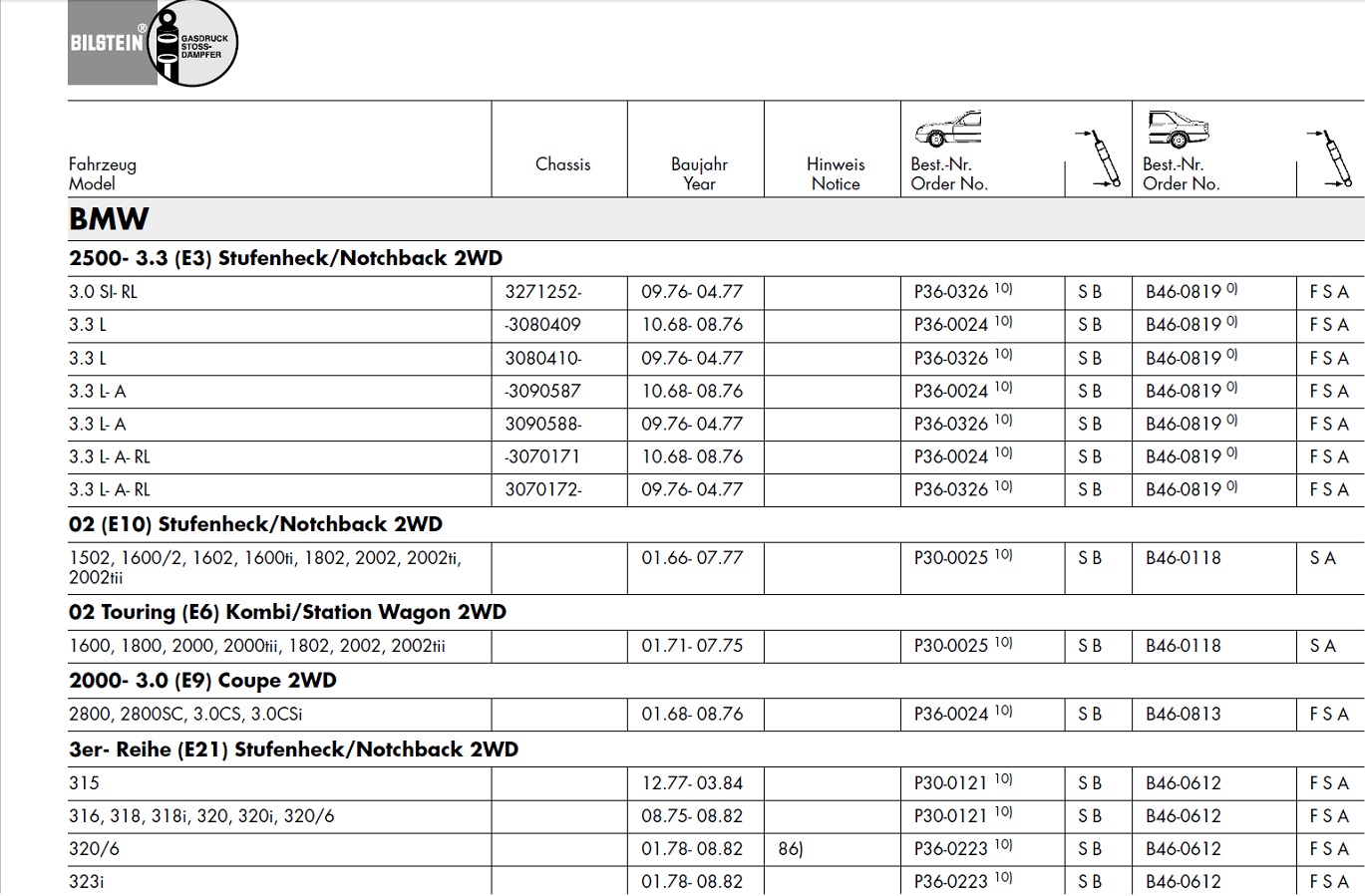
Even though 323 sports are NO LONGER AVAILABLE, Bilstein does have the dimensions. Ask them to compare the e21 323 size with the e30 6cyl/m3 size, SSDD


Product Name: Bilstein B6 Sport shocks VA BMW 323i E21 51mm Strut

Axis: 2 shocks for the front

Design: B6 Sport

Model: P36-0223

The early/late model e21 320i 4cyl model share the same front strut inserts, only the gland nut is different. The e21 323i uses a different setup altogether. Since Bilstein no longer makes Front Sport Strut inserts for the E21 323i, and if you want to use the E21 320i Bilstein Sport inserts on the 323i strut housing, then you would need the following gland nut from Bilstein--Bilstein P/N: B4-B30-U232A1.


The 323i front strut housing has a 36mm piston diameter. The 320i strut insert has a 30mm piston diameter. So, you need a male gland nut that has an inner diameter of 30 mm and a outer diameter of 36mm.

320i 45mm strut od, uses a 38mm insert (shock) which has a piston size 30mm

323 51mm strut, uses a 45mm insert, and has piston size of 36mm.


This is what Metric Motorsport said about building coil overs: "We use revalved VW Rabbit gti sport fronts, they are shorter, to maintain travel after lowering.The rabbit struts are from 1983 VW gti. As for spring rates, 350/275 is usually what we ship our coil overs with for street applications. I have 450/325 in my E21, But I have a S52.. I would say 375/300 should be a good place to start. the fronts should be around 100 LBS stiffer then the rears."
__________________


Gland nuts M45 x 1.5 (Secures the sturt insert inside the strut housing). 


Early (77-79)
31321115398 (BOGE)
31321130068 (BILSTEIN) <--- Has a different Bilstein part #

Late (80-83)
31321123901 (BOGE)
31321126275 (BILSTEIN) <--- Has a different Bilstein part #
Part # for a post-80s bilstein gland nut is B30-629 F1


Bilstein Sport Dampners
Front: P30-0125-H1
Rear: B46-0617-H0

Bilstein Heavy Duty Dampners
Front: P30-0121-H1
Rear: B46-0612-H0

323i Specific (any year)

Bilstein Heavy Duty Dampners
Front: P36-0223-H0
Rear B46-0612-H0

Gland Nuts M48 x 1.5
31321117376 (BOGE)
31321130069 (BILSTEIN) <--- Has a different Bilstein part #


AFTERMARKET & MOTORSPORTS
HEADQUARTERS - WEST

14102 Stowe Drive
Poway, CA. 92064
1-858-386-5900


http://www.bilsteinus.com/

Source: http://www.autosportgallery.com/305-%209-09applicationguide.pdf


When considering which shock to buy for an E21..consider the following between Sport/HD shocks...suspension works both ways (up and down), static sag is an important consideration.

if a billie sport has 115mm of travel then i would try to get 25-30% of static sag, or 32mm. then you still need to check the compression and make sure there is enough travel for bump.

the best way to do this is with a zip tie around the shock's shaft. with the car lifted tie a zip tie and slide it down onto the top of the shock, put the car down on it's wheels and then lift the car back up and measure the distance between the shock and the zip, that's the static sag.

take the car for a spin putting it hard into a corner or two. lift the car and measure the distance from the shock to the zip, this is the total shock travel. deduct the sag measurement and you have the amount of 'used' bump travel.

if the total used travel is as much or close to the length of the shock travel (115mm for billie sport) then you need stiffer springs. if the static sag is too little then softer springs are required.

the above is just a basic outline, but it gives you a good idea of what the suspension is doing. this is how we setup motorcycles where the results are much more critical than a car.

Spring Rate vs Wheel Rate


Spring Rate vs Wheel Rate


Spring rate is the amount of force it takes to compress a spring 1-inch.   Wheel rate is the spring rate actually measured at the wheel.   Both are expressed in lb/in.


In order to calculate wheel rate, you need to know the spring rate, the motion ratio and the spring angle, as shown above.   Then you can solve the following equation.


Wheel Rate = ( ( MotionRatio^2) * SpringRate ) * sine(Spring Angle)

When a spring is mounted in its stock position on the front of a 1979-2004 Mustang (shown on the right side, above) the motion ratio is about 0.50, and the wheel rate is about 0.25 x the spring rate.   That is, a 600 lb/in spring produces a wheel rate of about 150 lb/in.

If coilover springs are installed (shown left side, above) the spring is moved close to the wheel, the motion ratio becomes about 0.95, and the wheel rate is about 0.90 x the spring rate.   A much lighter 167 lb/in spring produces the same 150 lb/in wheel rate.

The chart below provides motion ratios and wheel rate factors that can be used to calculate an approximate wheel rate for a spring installed on a 1979-2004 Mustang.   To obtain the wheel rate, multiply the spring rate by the factor that corresponds to the spring type and position on the car (stock or coilover, front or rear).


1979-2004 MustangFrontRear
Spring TypeStockCoiloverStockCoilover
Motion Ratio0.500.950.701.05
Wheel Rate Factor0.250.900.491.10


Note: These numbers are approximations and this discussion omits some variables in the interest of simplicity.


What you have to do is first measure your suspension and weigh your corners. Get D1 and D2, spring angle (this is the angle of the shock to the lower control arm) and the coner weights from individual scales. Then pick a spring, this will be a ballpark spring rate.

Motion ratio = D1/D2

(motion ratio^2 x ballpark spring rate) x sine(spring angle) = wheel rate

"You want your wheel rate to be about 1/2 the unsprung corner weight at the corner. The unsprung weight is the corner weight minus the wheel, tire, brake system, hub (upright), coilover lower mount and 1/2 the lower control arm.
First: it should be clear at this point that there is a boatload of research that goes into suspension design. Use other people's efforts who have gone before you and buy at the very least "Competitiong Car Suspension" by Allan Staniforth and "Engineering to Win" by Carroll Smith. If you really want to know what's going on and you want to do all the math then buy "Race Car Vehicle Dynamics" by Milliken and Milliken, it's published by the SAE.
Secondly: what might not be so obvious is your new $300 camber plates just allowed you to change your spring angle, which changes your motion ratio and effectively makes your springs "softer" for a given spring rate. This is another reason you can't take someone elses spring rates and have them work directly for you.
Thirdly: That stiffer roll bar you just installed, yup, it changes your spring rate too.
Your spring rate is the amount of distance the spring compresses at a given weight. If you have a spring that compresses 1" with a weight of 250 lbs then it's a 250lbs/inch spring. If installed at the center of the wheel at 90 degree (impossible but makes the math easy) then the suspension spring rate is 250lbs/inch. If you add an anti roll bar then in roll it exerts a force from one corner to the other which increases the effective weight that the suspension can resist per inch. 
Sorry if this is odd sounding I'm on a phone and can't read what I wrote.
Think of it this way. If you have a bar, and it is one half of an anti roll bar, so it's a big L and it's connected to the suspension of one side like an anti roll bar but rather than held in a bushing on the chassis it's welded to the chassis then it will also resist suspension movement, It will act sort of like a big butterfly clip on it's side. It's just a different way to build a spring. In the case of the anti roll bar however it doesn't resist suspension movement if the other wheel is moving in the exact same way. So if you go over a curb with one wheel then the other wheel being connected resists the curb wheel's action. However if you go over a speed bump the anti roll bar doesn't really resist movement at all because both wheels are moving together.
--This is one reason you see big anti roll bars on luxury cars, you can get away with much lighter springs and still deal with road irregularities if you have a beefy anti roll bar. This makes the ride softer when you are just lumbering along on smooth roads or on the freeway.
--This is also why you see such small anti roll bars on F1 cars. They run such heavy springs that chassis flex and pneumatic tire deformation happens before the spring compresses, so anti roll bars don't really add much."  ~ milotrain


Source: http://www.miracerros.com/mustang/t_wheel_rate.htm