
Showing posts with label engine. Show all posts
Showing posts with label engine. Show all posts
Tuesday, January 7, 2020

Friday, September 26, 2014
BMW History of the S38 Engine
The History of the S38 engine
This article goes a bit deeper into the engine of our beloved E34 ///M5. Like you may have heard or read before, this engine is the result of an almost 20 year evolution of engine development at BMW ///M GmbH. But let's go a bit further into detail about its history. The intention of the article is not to explain the technical differences, but to give an overview of the evolution and to describe the legacy of the S38 engine.
It all started in 1973 when BMW needed a more powerful engine for the competition CSL's to compete with the Ford Capri's. Until then, BMW via Schnitzer and Alpina raced the CSL's with the M38 and M52 engines. These SOHC engines where based on the M06 engine from 1968. The M06 is the first version of the legendary engine family, which we all now know as the M30 big six.
Linking the M30 with the M06 may seem confusing, but it is not. In the early 1980's, BMW switched to a new system of coding their engines. Before then, an engine was designated by a three character long code and if applicable followed by a version (for example M90 or M49/1). The new engine coding used a six character long code and if applicable followed by one or more characters for engine specifics. The new engine code allowed BMW to specify its source (regular BMW or BMW Motorsport), the engine family and the displacement. Examples of the new engine codex are M30B35 and S62B50. The M06 engine from 1968 is coded according to the old coding system, while the M30B35 from 1985 is coded according to the new system. Some common engines with an 'old' ID code also received 'new' engine code. For instance the M06 is also know as the M30B25V with the V meaning "Vergasser" or Carburettor.
The M52 racing engine family created a base for the new 24-valve race engine coded M49. This new engine was developed by a new division lead by Jochen Neerpasch. Today we know that division as BMW Motorsport. Jochen Neerpasch managed to create a team with amongst others Paul Rosche, also known as "nocken Paul". The cylinder head of the M49 engine is almost similar to the M12/2 formula II engine. This means that the camshafts are driven by directly by gear train. This valve-train was driven by a single timing chain via an intermediate shaft. Theoretically this allowed the head to rev over 9000RPM. But since the crankshaft is larger than the four-cylinder Formula II engine, 9000RPM was the limit for the group 5 engine. The M49 equipped E9 CSL won it's first race in the European ETC series on the Salzburgrung in March 1974. A remarkable success, especially because it was also it's racing debut. The oil crisis of 1973 and the commercial lack of interest for high performance cars (the E20 2002 turbo being a good example) slowed down the development of the E9 CSLs. Four E9 CSLs with M49 engines entered the American IMSA series in 1975. Also in 1976, BMW participated in the American IMSA series. During these two years, BMW won 7 races.
In Europe, there was hardly any real competition and when plans for a group 5 class for the 1975 season did not materialize, the European E9 CSL's with M49 engines where sold of. Alpina bought at least one and about two years ago one of these cars showed up for sale in the Netherlands for about US$25000.
For the 1976 season, the oil crises was a few years back and BMW decided to enter the newly created group 5 series. By request of the factory, Josef Schnitzer further developed the M49 engine so it could be used for vertical installation in the CSL's engine bay. Vertical installation allowed the use of larger exhaust headers, a more optimized inlet system and the installation of a more efficient cooling system. This engine was named M49/3 and yielded 465hp @ 8500RPM. But compared top the Porsche 935 turbo, the E9 CSL with the atmospheric M49/3 engine did not have a chance to compete. That is why in a later stage, twin turbo chargers where added. This was the fifth evolution of the M49 engine and was called M49/4. The M49/4 had a 300cc smaller displacement. With a bore of 94.0mm, the M49/3 only had 6.0 mm gap between the cylinders. For the non-turbo charged engines, this was enough, but turbo-charged engines produce much more heat, which has to be removed efficiently. Reducing the bore is one of the ways to achieve this. Even today, reducing the bore is a common practice to create a larger gap between the cylinder walls to create larger cooling channels within turbo charged engines. The four-valve M49/4 engine allowed a relatively low turbo pressure. Usually, a boost of 1.3bar (18PSI) was used to yield a neat 750hp @ 9000RPM. This high power output came with a relatively high reliability of the engine. Although the CSL gearbox was not designed for such a power, it held up rather well during the races. The practical experiences with the M49/4 engine provided a basis for the development of the later E26 ///M1.
All in all, the M49 engine and the E9 CSL where very successful in the Group 2 European Touring Car (ETC) series. From 1973-1976, BMW won the championship in these series. Although the last CSLs where made in 1974 and the last E9 coupe's left the factory in December 1975, BMW Motorsport continued to support it in 1976, but could continue that in 1977 because it was an obsolete model. This was a logic consequence of the introduction of the E24 6 series and using the CSL longer would not benefit the sales of the new coupe. Private teams continued to use the E9 CSL until 1978 and even managed to win the European Touring car Championship (ETC in 1977 and 1978. The following table shows an overview of the M49 engines which where used in racing.
Table 1, M49 engine family
For the group 5 series, Jochen Neerpasch wanted a mid engined racing car. The development of the E26 ///M1 started in 1976. The idea was to develop a racecar first and a road car second. Since BMW did not have the capacity or the expertise to build a tube framed car, BMW Motorsport contacted Lamborghini to help with the development and the production of the chassis. But Lamborghini came into financial troubles and was not able to fulfill its commitments to BMW. This delayed the production of the E26 ///M1 with more than a year and by the time the production of the ///M1 started, the rules for the group 5 touring car championship where changed and ruled out mid engined sports cars. At that time, Jochen Neerpasch had his new racecar, but could not use it. Max Mosley of the FIA came up with a brilliant idea. A new race class was established specially for the ///M1. This new race class, the Group 4 Pro Car series was scheduled to take place before a Formula 1 race with a few formula 1 drivers and privateers.
The engine for the ///M1 was an evolution of the M49 engine of which the development stopped in 1977. However the new M88 had significant changes to allow it to be used as a production engine for road cars. The same changes were made when building the E26 ///M1 for sale as a road car, a requirement for the group 4 regulations. The Group 4 rules required that 400 units of that same car would be made within one year. The direct drive of the camshafts by a gear train was abandoned for a direct chain drive to reduce the interior noise. Like the M49, the M88 engine also used a Kugelfisher mechanical fuel injection system. The cylinder head of the M88 consisted of two pieces. The lower piece contained the intake and exhaust ports, the valves and the spark plugs. The upper piece contains the buckets, shims, camshafts and bearings
Compared to the M49/3, the M88 had a slightly smaller displacement (3453cc). This was achieved by reducing the bore slightly to 93.4mm. However the stroke of the engine remained the same (84,0mm). To test if the M88 engine would be reliable for a production engine, BMW placed the existing SOHC drive train on the M88 cylinder block. This engine, called M90 used a regular Bosch L-Jetronic (predecessor of the Motronic) fuel injection system and yielded 218hp.
The road going ///M1 used the M88 engine. The M88 yields 277hp @ 6500RPM and 330nm @ 5500RPM. This was more then enough to propel the 1418kg sports car in a little more than 20sec to the 200km/h mark.
Since the E26 ///M1 was designed for racing first, the M88 engine was heavily modified. For road use, the M88 is tuned to offer a good compromise between tractability, engine longevity and performance. Engine longevity is not that important for racing and for group 4 and 5 Procar races a lot more than 277hp was required. New camshafts, larger valves, reshaped ports, throttle slides instead of butterflies, forged pistons and a completely different exhaust system helped to increase the power to almost 500bhp. For Group 5 purposes, two turbo chargers where added. This version is known as the M88/2. Depending on the boost pressure, the power output was between 850bhp and 950bhp.
Table 2, M88 engine family
With the cease of the group 4 and group 5 races, BMW stopped to use the M88 engine for racing purposes and concentrated on developing race cars on basis of the E21 and later the E30 3 series. But in 1983, the M88 was used one more time to power the new top model of BMW, the E24 ///M635CSI. The regular 635CSI lacked the power to compete with Porsche's 928S and the Mercedes 500SEC. For the E24 ///M635CSI, the M88 was redesigned. The bore and stroke of the M88/3 engine remained the same as the M88. Also six individual butterfly valves where used for the M88/3. However, Bosch's Motronic, the first digital controlled fuel-management system that was used in production cars, replaced the M88's Kugelfisher fuel injection system. This allowed the compression ratio to rise to 10.5:1. Thanks to these changes, the power output rose to 286hp at 6500RPM. The torque rose slightly also to 340nm at 4500RPM. This was 500RPM lower than for the original M88 engine and this helped to improve the M88/3 abilities for daily use.
At the end of 1984, the M88/3 engine was also fitted in the E28 5 series. Unlike the ///M635CSI, the E28 version was not named ///M535I as this type was already given to another E28 with the M30B35 engine. Instead, the name ///M5 was chosen. Already from September 1984 till February 1985, a small number of E28 ///M5's where hand build by BMW Motorsport for a happy few. It was not before February 1985 before the E28 ///M5 was introduced to the public. In the mid eighties, unleaded fuel and the use of catalytic converters became more and more common in Western Europe, especially in the environment oriented Swiss and Austrian market's. The M88/3 engine did not have a catalyst. BMW did not want to be accused of being insensitive to the environment and decided against the introduction of the E28 ///M5 at the important Geneva car show. Instead, BMW released the E28 ///M5 at the Amsterdam car-show, reducing the potential risk of bad environmental publicity in the widerinternational press.
Despite that BMW already switched to a new engine codex in 1983, the new 24-valve engine kept the family code M88. It was not before 1986 when the S38 designation was used for the catalyst version of the M88/3. The S38 stands for, 'S' means that the engine is originated by BMW Motorsport, the '3' means that it is derived from the M30 engine family and last but not least, the '8' is chosen to make a reference to the legendary M88.
During the mid eighties, the ///M635CSI and the E28 ///M5 where only available in Western Europe. In the United States, there was a small but significant demand for these 'European only' cars. This gap in the United States market was served by 'gray market' importing companies. Realising this, BMW North America introduced Motorsport versions of the E24 and E28 in 1987, but their specifications where changed to meet the demands of the American market. To meet US exhaust emission regulations of that time, the catalyst equipped S38B35 replaced the M88/3. The S38B35 kept the M88/3s bore, stroke and cylinder head, but to install a catalytic converter, the compression ratio decreased from 10.5:1 to 9.8:1. The equally tuned exhaust headers of the M88/3 where replaced by log headers. Al these changes decreased the engine performance. The S38B35 delivered 260hp and a torque of 330nm (243lb/ft) at 4500RPM. The US E28 ///M5 and E24 ///M6 also had more options fitted, many of which in Europe could only be bought by special order. As a result, the US cars where noticeable heavier than the European cars and this had an impact to the cars performance. The European E28 ///M5 can do the 0-100km/h (0-62mp/h) sprint in just 6.5sec, while the US version needs 0.3sec more.
For the US and Japanese markets, The ///M635CSI was renamed to ///M6, while in Europe the ///M635CSI designation remained. The distinction between the ///M6 and ///M635CSI is the engine. The ///M6 always contains the S38B35 engine, while the ///M635CSI can have both. Despite the catalyst, the majority of the E28 ///M5s and E24 ///M635CSI in Europe where equipped with the M88/3 engine, thus no catalyst.
The production of the last E28s ceased at the end of 1987 after which the E34 succeed it. It was without any doubt that soon after the introduction of the E34, also a Motorsport version became available. The E34 ///M5 was available for the German market in September 1988. The engine which powered the E34 ///M5 is a further evolution of the S38B35 engine which powered the catalyst versions of both the E28 ///M5 and E24 ///M635CSI. The E24 ///M635CSI remained in production until its demise in spring 1989. During that time, the M88/3 and S38B35 engine where by BMW Motorsport alongside the S38B36. This was of benefit for the last E24 ///M635CSIs because in their last production months, both the M88/3 and S38B35 engines received the duplex timing chain of the S38B36.
Table 3, S38 engine family
To create the S38B36, the S38B35 was stroked from 84.0mm to 86.0mm, the same as the M30B35 engine. The stroke remained 93.4mm. This all increased the displacement to 3535cc. Actually, this is 3.5 liter's and not 3.6 as the type designation indicates. However to make a distinction with the S38B35, the S38B36 engine was marked as a 3.6 liter engine. Not only the stroke was changed. Also the Compression ration increased from 9.8:1 to 10.0:1. The S38B36 delivered 315hp @ 6900RPM and 360nm (269lb/ft) at 4750RPM.
The intake received an electronically controlled RAM induction system to boost up the torque. A changeover valve varies the effective length of the induction system depending on load and engine speed. The changeover valve operates when the engine speed is below 4120RPM and full throttle or the engine speed is above 6720RPM and full throttle. The engine management remained the Bosch Motronic system, but instead of measuring the airflow with a valve, the S38B36 received an airflow measurement system based on a hot-wire sensor. In contrary to a conventional sensor with an air-valve and potentiometer, hot-wire sensors measures the mass of the air and since it is only a very thin wire, the air can flow to the intake-plenum without restriction- reducing flow resonance and noise.
To fulfill the exhaust emission regulations, a ceramic catalytic converter has been added to the exhaust system. To control the emissions at cold-engine start up an air injection feature for the exhaust has been added. This system injects air into the exhaust system to convert carbon monoxide into carbon dioxide and hydrogen into water. For Tropical regions, for instance the Middle East and south East Asia got a slightly different version of the S38B36. For these markets the compression ratio reduced to 9.2:1.
In 1991, the E34 ///M5 got competition by the Mercedes Benz 500E and of lesser importance, the Opel Lotus Omega and the BMW-Alpina B10 Bi-Turbo. Neither the Opel nor the Mercedes could match the ///M5 in character and driving abilities, but they where more powerful. The Opel Lotus Omega has a twin turbocharged 3.6 litre 24-valve engine and was (a cheaper) competitor for Alpina's B10 Biturbo. The 500E however was directly positioned as a competitor to the ///M5. Compared to the E34 ///M5, the 500Es strength was its torque (the a 5.0 liter 32-valve V8 produced 480Nm). The 500E was approximately 100kg heavier than the E34 ///M5, and was a polished autobahn performer. In all other areas the E34 ///M5 chassis performed better however. Ever keen to compete against Mercedes, BMW Motorsport redesigned the S38 to gain back the "fastest 4 door saloon" title.
The bore and stroke where increased one more time. As a result the displacement grew to 3795cc. Another significant change is the compression ratio that was increased to 10.5:1. The intake and exhaust ports increased in size also and each spark plug got it's own HV coil which eliminated the distributor rotor and the high voltage wiring. A smaller and lighter Emitec metallic type replaced the ceramic catalytic converter. The main advantage of the Emitec metallic converter is that it increases the flow of the exhaust gasses. The Bosch Motronic 1.2 fuel management system was changed for the Motronic 3.3 system of the same manufacturer that also includes the resonance flap control. This feature is the same as on the S38B36, but with an extra switch-point at 2480RPM.
The S38B38 was the last evolution within the S38 engine family and delivered 347hp @ 6900RPM and 409nm torque at 4750RPM. All these changes stretched the S38 to its limit. The web spacing between two cylinders with 5.4mm is extremely narrow. This is 0.6mm less that the M49/3 racing engine. The S38B38 engine remained in production until the summer of 1995 when the last E34 ///M5s left the production facility in Garching.
For the Swiss and Austrian market, the S38B38s where fitted with Ceramic catalytic converter and the smaller exhaust manifolds (80mm vs. 90mm) of the S38B36 engine. As a result, the Austrian and Swiss version did not deliver 347hp, but 327hp.
Post S38 period
S50B30, S50B32, S50B30 US and S52B32
In 1992, BMW introduced the E36 ///M3 coupe with the S50B30 engine. The S50B30 is based on the smaller M50 engine family, but had a completely new 24-valve head. All in the ///M tradition, this engine also has 6 individual butterfly valves. Completely new was the VANOS system to vary the intake camshaft and thus the timing of the intake valves. This means more torque at lower revs. The S50B30 engine measured 2990cc and delivered 286bhp @ 7000RPM and 320nm @ 3700RPM. The US did not get this expensive engine as it did not comply with emissions regulations. Essentially the S50B30 US is just a bored and stroked M50B25 with VANOS, meaning they skipped the 6 throttle bodies and the expensive head construction resulting in an overall power loss of 46hp.
In 1995, the S50B30 was bored and stroked one more time to 3201cc. Other significant changes are that the DME was now a system developed by BMW and Siemens. Also the exhaust camshaft timing is controlled by VANOS. Power rose to 321hp at a staggeringly high 7600RPM. The US again got a detuned version without the S50B32's expensive cylinder head and intake system. Compared to the S50B30 US, the S52B32 delivered the same power, but more torque at lower revs. For the E46 ///M3 of 2000, this engine was completely redesigned and thus called S54B32. Like the S38B38, this engine is also stretched to its limit.
S62B50
When the E39 succeeded the E34 in 1996, it took almost three years before it was succeeded by the E39 ///M5. Originally, BMW did not plan a Motorsport version of the E39 as it felt that the E39 540I and the E36 ///M3 4 door would fulfill the demands of the E34 ///M5 owners. However the ///M5 customers did not buy that, probably since neither the E36 ///M3 or the E39 540I are really exclusive cars. In 1997 BMW realised that and started to develop the third generation of the E39 ///M5. The first prototype was shown to journalists on the IAA car-show of 1997, but it was not before December 1998 that the first E39 ///M5s where delivered to customers. Instead of an inline six, BMW used the M62 V8 engine as the basis for the S62B50 power plant with 400bhp. The E39 ///M5 turned out as a very successful car, especially in the USA. Already in the summer of 2001, BMW had manufactured more E39 ///M5's than E34 ///M5's in a seven-year period!
Unlike the E28 and E34 ///M5, the E39 ///M5 was not hand build in Garching anymore, but manufactured on the E39 production line in Dingolfing. Thanks to this, the German MSRP of DM140000 for the E39 ///M5 in 1998 was almost the same as the customer cost for the last E34 ///M5 in 1995.
Developments related the S38
M90
The M90 was the first road going BMW engine with 3.5 litre displacement. Originally this engine was used to test if the M88 engine was reliable with the narrow web spacing of 6.6mm. This means that this engine has exactly the same bore and stroke as the M88 and is directly related. However instead of a DOHC cylinder head with 24 valves, BMW used the SOHC cylinder head with 12 valves. The use of an electronically controlled fuel management system (Bosch LE-Jetronic) allowed a slightly higher compression of 9.3:1. Strictly, the M90 engine is not an M production engine although the E12 ///M535I in which it is used is a real M car. Until 1981, the M90 engine was used for the early 635CSI and the very rare and delectable E12 ///M535I from 1980.
In 1981 and 1982, Alpina used the last batch of the M90 engine to power the last versions of the B7 turbo versions of the E12 sedan and E24 coupe. For the B7S turbo, the M90 has been modified extensively to allow the use of a turbocharger. The B7S delivered 330hp @ 5800RPM and 500nm @3000RPM. During 1981 and 1982, Alpina only made 60 E12 sedans and 30 E24 coupe's in the B7S version.
M30B35
To improve the reliability for road use, BMW redesigned the M90 engine in 1981. This engine, called M30B35 was slightly different. Compared to the M90, the M30B35 has a larger stroke (86,0mm), but a smaller bore (92,5mm). The use of a digital controlled fuel management system (DME) allowed to increase the compression ratio from 9,1:1 to 10,0:1. Although the engine capacity decreased slightly (3430cc vs. 3453cc), power and torque remained almost the same. The M30B35 remained in production for almost 13 years and in the late 1980's, catalyst versions where developed and offered for sale also. The M30B35 has been used in the E23 735I, the E24/1 635CSI, the E28 535I, the E28 M535I, the E32 735I and the E34 535I.
This engine was also used a lot by tuners and the tuners with a manufacturer status such as Hartge and Alpina. Alpina examples are the E28 B7 turbo, the E24/1 B7 turbo, the E28 B9, the E30 B6(S), the E28 B10 3.5, and the E34 B10 3.5 and last but not least the E34 B10 Biturbo. In 1993, the last 50 M30B35 engines where delivered to Alpina for the last 50 B10 Bi-Turbos.
Table 4, M88 engine derivatives
S14B20, S14B23 and S14B25
This engine family was developed in the early 1980's for use within the E30 series where it had to power the new BMW touring car racer, the E30 ///M3. The engine block was based on the cast iron M10 engine family. The cylinder centres of the M10 (at 100mm) are the same as on the M88 so this allowed BMW Motorsport to simply cut of two cylinders of the existing M88 cylinder head. The bore (93.4mm), stroke (84.0mm) and compression ratio (10.5:1) for the S14B23 where chosen exactly the same as the M88/3. This created a displacement of 2302cc. Enough to deliver 200hp @ 6750RPM and 176lb/ft of torque at 4750RPM. With catalyst this engine delivered 195hp and 169lb/ft @ 4750RPM. In Italy, there was the 320iS, a deviation of the E30 ///M3 to avoid the huge Italian taxes for road cars above two liters. The 320iS simply used the 325iS-body style, but powered by an S14B20 engine. The S14B20 has the same bore as the S14B23, but a smaller stroke (72.6mm) resulting in a displacement of 1990cc. A compression ratio of 10.8:1 still allowed 192hp at a stunning 6900RPM.
In September 986, the first E30 ///M3's where sold to their first customers and within the first year, more than 5000 units where sold to meet the FISA Group A rules. 2396 where build in 1986 and 6396 in 1987 and thus easily satisfying the rule makers. It did not take long before the first evolution versions arrived.
For the evolution II models of 1988, BMW Motorsport fitted other pistons to increase the compression ratio to 11.0:0. The displacement and the cylinder head construction are exactly the same as the regular 2.3 liter. But now 220hp and 181lb/ft where available. In a later stage, this engine with a catalyst became available for the E30 ///M3 Cecotto and Ravaglia editions.
The last version of the S14 engine is the S14B25. An increased bore (now 95.5mm) and stroke (87.0mm) increased the displacement to 2483cc. The compression ratio remained 10.5:1. At 7000RPM this is enough for 238 hp and 177lb/ft @ 4750RPM. This engine is used for the last 600 ///M30 evolution III, the most delectable of all ///M3s.
The primary purpose for the S14 engine was to power the E30 ///M3 touring car racer which raced in different European touring car series of which the most important was the DTM (German Touring car championship). For these many engine versions where made (S14/1 till S14/7).
When the production of the E30 ///M3 ceased in March 1990, more than 17000 of these cars have been made and found their way to very happy owners. In terms of nimbleness, driving satisfaction and performance this may be the ultimate ///M car ever made. Apart from these, more than 3000 320iS cars found their way to Italian customers.
Tuner Efforts
Although the engines from the S38 and M88 have a high state of tune when they left the factory, for some this was not enough. Especially in the USA, there was a demand for even higher power output. A few enthusiastic companies served this niche in the market and offered tuning kit's that could be acquired separately or together as a complete package. In Europe, BMW's where mostly tuned as a complete package. Good examples are companies like Alpina and Hartge. Hartge actually did tune the S38 engine family, but Alpina never touched a BMW-Motorsport engine. Although many companies actually tuned the S38, it is undoable to describe all efforts in this field.
Dinan-BMW
Steve Dinan grounded this California based company, almost 20 years ago. Unlike many European counterparts, Dinan offers their performance program as kits that can be bought seperately or as a complete package. In 1986, Dinan developed a turbocharged version of the S38B35 engine. For the E34 ///M5's S38B36, Dinan developed several tuning programs known as Stages. Dinan's program starts with a modified DME, other cam sprockets to retard the timing for more torque in the low en mid range and a stroker kit to increase the S38B36 to 3,9 liters (3880cc). Added to that, you can buy the companies modified camshafts. In the strongest program, Dinan claims 402bhp (SAE). Even today, almost 9 years after the last E34 ///M5 was officially imported into the US, Dinan still offers these programs to the E34 M5 owners.
Hartge
In Europe, the S38 and M88 were less prone by tuner efforts. A Company that did was Hartge. Hartge fitted hotter cams to the M88/3 and reprogrammed the DME. erent cams and another DME program. With 330hp @ 7000RPM and 260lb/ft @ 3500RPM, this is a serious improvement. This engine was fitted in amongst others the Hartge H5SP-24, their version of the E28 M5. Hartge also used this engine for the H36, an E30 ///M3 equiped with the Hartge's modified M88/3. Only six of these beasts where ever build.
Notes:
1.The M30B35 was used in many ranges and cars. The most important are the E28 535I & ///M535I, the 635CSI after 1982, the E23 735I, the E32 735I and last but not least the E34 535I.
2.All power figures in the article are DIN. According to SAE the power is slightly smaller.
3.The torque in lb./ft can be calculated by multiplying the nm. Figure with 0.73529
References:
Acknowledgements:
1.BMW Mobile tradition by person of Mr. Jakobson for providing technical information about the M49, M88 & S38 engine families.
This article goes a bit deeper into the engine of our beloved E34 ///M5. Like you may have heard or read before, this engine is the result of an almost 20 year evolution of engine development at BMW ///M GmbH. But let's go a bit further into detail about its history. The intention of the article is not to explain the technical differences, but to give an overview of the evolution and to describe the legacy of the S38 engine.
It all started in 1973 when BMW needed a more powerful engine for the competition CSL's to compete with the Ford Capri's. Until then, BMW via Schnitzer and Alpina raced the CSL's with the M38 and M52 engines. These SOHC engines where based on the M06 engine from 1968. The M06 is the first version of the legendary engine family, which we all now know as the M30 big six.
Linking the M30 with the M06 may seem confusing, but it is not. In the early 1980's, BMW switched to a new system of coding their engines. Before then, an engine was designated by a three character long code and if applicable followed by a version (for example M90 or M49/1). The new engine coding used a six character long code and if applicable followed by one or more characters for engine specifics. The new engine code allowed BMW to specify its source (regular BMW or BMW Motorsport), the engine family and the displacement. Examples of the new engine codex are M30B35 and S62B50. The M06 engine from 1968 is coded according to the old coding system, while the M30B35 from 1985 is coded according to the new system. Some common engines with an 'old' ID code also received 'new' engine code. For instance the M06 is also know as the M30B25V with the V meaning "Vergasser" or Carburettor.
The M52 racing engine family created a base for the new 24-valve race engine coded M49. This new engine was developed by a new division lead by Jochen Neerpasch. Today we know that division as BMW Motorsport. Jochen Neerpasch managed to create a team with amongst others Paul Rosche, also known as "nocken Paul". The cylinder head of the M49 engine is almost similar to the M12/2 formula II engine. This means that the camshafts are driven by directly by gear train. This valve-train was driven by a single timing chain via an intermediate shaft. Theoretically this allowed the head to rev over 9000RPM. But since the crankshaft is larger than the four-cylinder Formula II engine, 9000RPM was the limit for the group 5 engine. The M49 equipped E9 CSL won it's first race in the European ETC series on the Salzburgrung in March 1974. A remarkable success, especially because it was also it's racing debut. The oil crisis of 1973 and the commercial lack of interest for high performance cars (the E20 2002 turbo being a good example) slowed down the development of the E9 CSLs. Four E9 CSLs with M49 engines entered the American IMSA series in 1975. Also in 1976, BMW participated in the American IMSA series. During these two years, BMW won 7 races.
In Europe, there was hardly any real competition and when plans for a group 5 class for the 1975 season did not materialize, the European E9 CSL's with M49 engines where sold of. Alpina bought at least one and about two years ago one of these cars showed up for sale in the Netherlands for about US$25000.
For the 1976 season, the oil crises was a few years back and BMW decided to enter the newly created group 5 series. By request of the factory, Josef Schnitzer further developed the M49 engine so it could be used for vertical installation in the CSL's engine bay. Vertical installation allowed the use of larger exhaust headers, a more optimized inlet system and the installation of a more efficient cooling system. This engine was named M49/3 and yielded 465hp @ 8500RPM. But compared top the Porsche 935 turbo, the E9 CSL with the atmospheric M49/3 engine did not have a chance to compete. That is why in a later stage, twin turbo chargers where added. This was the fifth evolution of the M49 engine and was called M49/4. The M49/4 had a 300cc smaller displacement. With a bore of 94.0mm, the M49/3 only had 6.0 mm gap between the cylinders. For the non-turbo charged engines, this was enough, but turbo-charged engines produce much more heat, which has to be removed efficiently. Reducing the bore is one of the ways to achieve this. Even today, reducing the bore is a common practice to create a larger gap between the cylinder walls to create larger cooling channels within turbo charged engines. The four-valve M49/4 engine allowed a relatively low turbo pressure. Usually, a boost of 1.3bar (18PSI) was used to yield a neat 750hp @ 9000RPM. This high power output came with a relatively high reliability of the engine. Although the CSL gearbox was not designed for such a power, it held up rather well during the races. The practical experiences with the M49/4 engine provided a basis for the development of the later E26 ///M1.
All in all, the M49 engine and the E9 CSL where very successful in the Group 2 European Touring Car (ETC) series. From 1973-1976, BMW won the championship in these series. Although the last CSLs where made in 1974 and the last E9 coupe's left the factory in December 1975, BMW Motorsport continued to support it in 1976, but could continue that in 1977 because it was an obsolete model. This was a logic consequence of the introduction of the E24 6 series and using the CSL longer would not benefit the sales of the new coupe. Private teams continued to use the E9 CSL until 1978 and even managed to win the European Touring car Championship (ETC in 1977 and 1978. The following table shows an overview of the M49 engines which where used in racing.
Table 1, M49 engine family
For the group 5 series, Jochen Neerpasch wanted a mid engined racing car. The development of the E26 ///M1 started in 1976. The idea was to develop a racecar first and a road car second. Since BMW did not have the capacity or the expertise to build a tube framed car, BMW Motorsport contacted Lamborghini to help with the development and the production of the chassis. But Lamborghini came into financial troubles and was not able to fulfill its commitments to BMW. This delayed the production of the E26 ///M1 with more than a year and by the time the production of the ///M1 started, the rules for the group 5 touring car championship where changed and ruled out mid engined sports cars. At that time, Jochen Neerpasch had his new racecar, but could not use it. Max Mosley of the FIA came up with a brilliant idea. A new race class was established specially for the ///M1. This new race class, the Group 4 Pro Car series was scheduled to take place before a Formula 1 race with a few formula 1 drivers and privateers.
The engine for the ///M1 was an evolution of the M49 engine of which the development stopped in 1977. However the new M88 had significant changes to allow it to be used as a production engine for road cars. The same changes were made when building the E26 ///M1 for sale as a road car, a requirement for the group 4 regulations. The Group 4 rules required that 400 units of that same car would be made within one year. The direct drive of the camshafts by a gear train was abandoned for a direct chain drive to reduce the interior noise. Like the M49, the M88 engine also used a Kugelfisher mechanical fuel injection system. The cylinder head of the M88 consisted of two pieces. The lower piece contained the intake and exhaust ports, the valves and the spark plugs. The upper piece contains the buckets, shims, camshafts and bearings
Compared to the M49/3, the M88 had a slightly smaller displacement (3453cc). This was achieved by reducing the bore slightly to 93.4mm. However the stroke of the engine remained the same (84,0mm). To test if the M88 engine would be reliable for a production engine, BMW placed the existing SOHC drive train on the M88 cylinder block. This engine, called M90 used a regular Bosch L-Jetronic (predecessor of the Motronic) fuel injection system and yielded 218hp.
The road going ///M1 used the M88 engine. The M88 yields 277hp @ 6500RPM and 330nm @ 5500RPM. This was more then enough to propel the 1418kg sports car in a little more than 20sec to the 200km/h mark.
Since the E26 ///M1 was designed for racing first, the M88 engine was heavily modified. For road use, the M88 is tuned to offer a good compromise between tractability, engine longevity and performance. Engine longevity is not that important for racing and for group 4 and 5 Procar races a lot more than 277hp was required. New camshafts, larger valves, reshaped ports, throttle slides instead of butterflies, forged pistons and a completely different exhaust system helped to increase the power to almost 500bhp. For Group 5 purposes, two turbo chargers where added. This version is known as the M88/2. Depending on the boost pressure, the power output was between 850bhp and 950bhp.
Table 2, M88 engine family
With the cease of the group 4 and group 5 races, BMW stopped to use the M88 engine for racing purposes and concentrated on developing race cars on basis of the E21 and later the E30 3 series. But in 1983, the M88 was used one more time to power the new top model of BMW, the E24 ///M635CSI. The regular 635CSI lacked the power to compete with Porsche's 928S and the Mercedes 500SEC. For the E24 ///M635CSI, the M88 was redesigned. The bore and stroke of the M88/3 engine remained the same as the M88. Also six individual butterfly valves where used for the M88/3. However, Bosch's Motronic, the first digital controlled fuel-management system that was used in production cars, replaced the M88's Kugelfisher fuel injection system. This allowed the compression ratio to rise to 10.5:1. Thanks to these changes, the power output rose to 286hp at 6500RPM. The torque rose slightly also to 340nm at 4500RPM. This was 500RPM lower than for the original M88 engine and this helped to improve the M88/3 abilities for daily use.
At the end of 1984, the M88/3 engine was also fitted in the E28 5 series. Unlike the ///M635CSI, the E28 version was not named ///M535I as this type was already given to another E28 with the M30B35 engine. Instead, the name ///M5 was chosen. Already from September 1984 till February 1985, a small number of E28 ///M5's where hand build by BMW Motorsport for a happy few. It was not before February 1985 before the E28 ///M5 was introduced to the public. In the mid eighties, unleaded fuel and the use of catalytic converters became more and more common in Western Europe, especially in the environment oriented Swiss and Austrian market's. The M88/3 engine did not have a catalyst. BMW did not want to be accused of being insensitive to the environment and decided against the introduction of the E28 ///M5 at the important Geneva car show. Instead, BMW released the E28 ///M5 at the Amsterdam car-show, reducing the potential risk of bad environmental publicity in the widerinternational press.
Despite that BMW already switched to a new engine codex in 1983, the new 24-valve engine kept the family code M88. It was not before 1986 when the S38 designation was used for the catalyst version of the M88/3. The S38 stands for, 'S' means that the engine is originated by BMW Motorsport, the '3' means that it is derived from the M30 engine family and last but not least, the '8' is chosen to make a reference to the legendary M88.
During the mid eighties, the ///M635CSI and the E28 ///M5 where only available in Western Europe. In the United States, there was a small but significant demand for these 'European only' cars. This gap in the United States market was served by 'gray market' importing companies. Realising this, BMW North America introduced Motorsport versions of the E24 and E28 in 1987, but their specifications where changed to meet the demands of the American market. To meet US exhaust emission regulations of that time, the catalyst equipped S38B35 replaced the M88/3. The S38B35 kept the M88/3s bore, stroke and cylinder head, but to install a catalytic converter, the compression ratio decreased from 10.5:1 to 9.8:1. The equally tuned exhaust headers of the M88/3 where replaced by log headers. Al these changes decreased the engine performance. The S38B35 delivered 260hp and a torque of 330nm (243lb/ft) at 4500RPM. The US E28 ///M5 and E24 ///M6 also had more options fitted, many of which in Europe could only be bought by special order. As a result, the US cars where noticeable heavier than the European cars and this had an impact to the cars performance. The European E28 ///M5 can do the 0-100km/h (0-62mp/h) sprint in just 6.5sec, while the US version needs 0.3sec more.
For the US and Japanese markets, The ///M635CSI was renamed to ///M6, while in Europe the ///M635CSI designation remained. The distinction between the ///M6 and ///M635CSI is the engine. The ///M6 always contains the S38B35 engine, while the ///M635CSI can have both. Despite the catalyst, the majority of the E28 ///M5s and E24 ///M635CSI in Europe where equipped with the M88/3 engine, thus no catalyst.
The production of the last E28s ceased at the end of 1987 after which the E34 succeed it. It was without any doubt that soon after the introduction of the E34, also a Motorsport version became available. The E34 ///M5 was available for the German market in September 1988. The engine which powered the E34 ///M5 is a further evolution of the S38B35 engine which powered the catalyst versions of both the E28 ///M5 and E24 ///M635CSI. The E24 ///M635CSI remained in production until its demise in spring 1989. During that time, the M88/3 and S38B35 engine where by BMW Motorsport alongside the S38B36. This was of benefit for the last E24 ///M635CSIs because in their last production months, both the M88/3 and S38B35 engines received the duplex timing chain of the S38B36.
Table 3, S38 engine family
To create the S38B36, the S38B35 was stroked from 84.0mm to 86.0mm, the same as the M30B35 engine. The stroke remained 93.4mm. This all increased the displacement to 3535cc. Actually, this is 3.5 liter's and not 3.6 as the type designation indicates. However to make a distinction with the S38B35, the S38B36 engine was marked as a 3.6 liter engine. Not only the stroke was changed. Also the Compression ration increased from 9.8:1 to 10.0:1. The S38B36 delivered 315hp @ 6900RPM and 360nm (269lb/ft) at 4750RPM.
The intake received an electronically controlled RAM induction system to boost up the torque. A changeover valve varies the effective length of the induction system depending on load and engine speed. The changeover valve operates when the engine speed is below 4120RPM and full throttle or the engine speed is above 6720RPM and full throttle. The engine management remained the Bosch Motronic system, but instead of measuring the airflow with a valve, the S38B36 received an airflow measurement system based on a hot-wire sensor. In contrary to a conventional sensor with an air-valve and potentiometer, hot-wire sensors measures the mass of the air and since it is only a very thin wire, the air can flow to the intake-plenum without restriction- reducing flow resonance and noise.
To fulfill the exhaust emission regulations, a ceramic catalytic converter has been added to the exhaust system. To control the emissions at cold-engine start up an air injection feature for the exhaust has been added. This system injects air into the exhaust system to convert carbon monoxide into carbon dioxide and hydrogen into water. For Tropical regions, for instance the Middle East and south East Asia got a slightly different version of the S38B36. For these markets the compression ratio reduced to 9.2:1.
In 1991, the E34 ///M5 got competition by the Mercedes Benz 500E and of lesser importance, the Opel Lotus Omega and the BMW-Alpina B10 Bi-Turbo. Neither the Opel nor the Mercedes could match the ///M5 in character and driving abilities, but they where more powerful. The Opel Lotus Omega has a twin turbocharged 3.6 litre 24-valve engine and was (a cheaper) competitor for Alpina's B10 Biturbo. The 500E however was directly positioned as a competitor to the ///M5. Compared to the E34 ///M5, the 500Es strength was its torque (the a 5.0 liter 32-valve V8 produced 480Nm). The 500E was approximately 100kg heavier than the E34 ///M5, and was a polished autobahn performer. In all other areas the E34 ///M5 chassis performed better however. Ever keen to compete against Mercedes, BMW Motorsport redesigned the S38 to gain back the "fastest 4 door saloon" title.
The bore and stroke where increased one more time. As a result the displacement grew to 3795cc. Another significant change is the compression ratio that was increased to 10.5:1. The intake and exhaust ports increased in size also and each spark plug got it's own HV coil which eliminated the distributor rotor and the high voltage wiring. A smaller and lighter Emitec metallic type replaced the ceramic catalytic converter. The main advantage of the Emitec metallic converter is that it increases the flow of the exhaust gasses. The Bosch Motronic 1.2 fuel management system was changed for the Motronic 3.3 system of the same manufacturer that also includes the resonance flap control. This feature is the same as on the S38B36, but with an extra switch-point at 2480RPM.
The S38B38 was the last evolution within the S38 engine family and delivered 347hp @ 6900RPM and 409nm torque at 4750RPM. All these changes stretched the S38 to its limit. The web spacing between two cylinders with 5.4mm is extremely narrow. This is 0.6mm less that the M49/3 racing engine. The S38B38 engine remained in production until the summer of 1995 when the last E34 ///M5s left the production facility in Garching.
For the Swiss and Austrian market, the S38B38s where fitted with Ceramic catalytic converter and the smaller exhaust manifolds (80mm vs. 90mm) of the S38B36 engine. As a result, the Austrian and Swiss version did not deliver 347hp, but 327hp.
Post S38 period
S50B30, S50B32, S50B30 US and S52B32
In 1992, BMW introduced the E36 ///M3 coupe with the S50B30 engine. The S50B30 is based on the smaller M50 engine family, but had a completely new 24-valve head. All in the ///M tradition, this engine also has 6 individual butterfly valves. Completely new was the VANOS system to vary the intake camshaft and thus the timing of the intake valves. This means more torque at lower revs. The S50B30 engine measured 2990cc and delivered 286bhp @ 7000RPM and 320nm @ 3700RPM. The US did not get this expensive engine as it did not comply with emissions regulations. Essentially the S50B30 US is just a bored and stroked M50B25 with VANOS, meaning they skipped the 6 throttle bodies and the expensive head construction resulting in an overall power loss of 46hp.
In 1995, the S50B30 was bored and stroked one more time to 3201cc. Other significant changes are that the DME was now a system developed by BMW and Siemens. Also the exhaust camshaft timing is controlled by VANOS. Power rose to 321hp at a staggeringly high 7600RPM. The US again got a detuned version without the S50B32's expensive cylinder head and intake system. Compared to the S50B30 US, the S52B32 delivered the same power, but more torque at lower revs. For the E46 ///M3 of 2000, this engine was completely redesigned and thus called S54B32. Like the S38B38, this engine is also stretched to its limit.
S62B50
When the E39 succeeded the E34 in 1996, it took almost three years before it was succeeded by the E39 ///M5. Originally, BMW did not plan a Motorsport version of the E39 as it felt that the E39 540I and the E36 ///M3 4 door would fulfill the demands of the E34 ///M5 owners. However the ///M5 customers did not buy that, probably since neither the E36 ///M3 or the E39 540I are really exclusive cars. In 1997 BMW realised that and started to develop the third generation of the E39 ///M5. The first prototype was shown to journalists on the IAA car-show of 1997, but it was not before December 1998 that the first E39 ///M5s where delivered to customers. Instead of an inline six, BMW used the M62 V8 engine as the basis for the S62B50 power plant with 400bhp. The E39 ///M5 turned out as a very successful car, especially in the USA. Already in the summer of 2001, BMW had manufactured more E39 ///M5's than E34 ///M5's in a seven-year period!
Unlike the E28 and E34 ///M5, the E39 ///M5 was not hand build in Garching anymore, but manufactured on the E39 production line in Dingolfing. Thanks to this, the German MSRP of DM140000 for the E39 ///M5 in 1998 was almost the same as the customer cost for the last E34 ///M5 in 1995.
Developments related the S38
M90
The M90 was the first road going BMW engine with 3.5 litre displacement. Originally this engine was used to test if the M88 engine was reliable with the narrow web spacing of 6.6mm. This means that this engine has exactly the same bore and stroke as the M88 and is directly related. However instead of a DOHC cylinder head with 24 valves, BMW used the SOHC cylinder head with 12 valves. The use of an electronically controlled fuel management system (Bosch LE-Jetronic) allowed a slightly higher compression of 9.3:1. Strictly, the M90 engine is not an M production engine although the E12 ///M535I in which it is used is a real M car. Until 1981, the M90 engine was used for the early 635CSI and the very rare and delectable E12 ///M535I from 1980.
In 1981 and 1982, Alpina used the last batch of the M90 engine to power the last versions of the B7 turbo versions of the E12 sedan and E24 coupe. For the B7S turbo, the M90 has been modified extensively to allow the use of a turbocharger. The B7S delivered 330hp @ 5800RPM and 500nm @3000RPM. During 1981 and 1982, Alpina only made 60 E12 sedans and 30 E24 coupe's in the B7S version.
M30B35
To improve the reliability for road use, BMW redesigned the M90 engine in 1981. This engine, called M30B35 was slightly different. Compared to the M90, the M30B35 has a larger stroke (86,0mm), but a smaller bore (92,5mm). The use of a digital controlled fuel management system (DME) allowed to increase the compression ratio from 9,1:1 to 10,0:1. Although the engine capacity decreased slightly (3430cc vs. 3453cc), power and torque remained almost the same. The M30B35 remained in production for almost 13 years and in the late 1980's, catalyst versions where developed and offered for sale also. The M30B35 has been used in the E23 735I, the E24/1 635CSI, the E28 535I, the E28 M535I, the E32 735I and the E34 535I.
This engine was also used a lot by tuners and the tuners with a manufacturer status such as Hartge and Alpina. Alpina examples are the E28 B7 turbo, the E24/1 B7 turbo, the E28 B9, the E30 B6(S), the E28 B10 3.5, and the E34 B10 3.5 and last but not least the E34 B10 Biturbo. In 1993, the last 50 M30B35 engines where delivered to Alpina for the last 50 B10 Bi-Turbos.
Table 4, M88 engine derivatives
S14B20, S14B23 and S14B25
This engine family was developed in the early 1980's for use within the E30 series where it had to power the new BMW touring car racer, the E30 ///M3. The engine block was based on the cast iron M10 engine family. The cylinder centres of the M10 (at 100mm) are the same as on the M88 so this allowed BMW Motorsport to simply cut of two cylinders of the existing M88 cylinder head. The bore (93.4mm), stroke (84.0mm) and compression ratio (10.5:1) for the S14B23 where chosen exactly the same as the M88/3. This created a displacement of 2302cc. Enough to deliver 200hp @ 6750RPM and 176lb/ft of torque at 4750RPM. With catalyst this engine delivered 195hp and 169lb/ft @ 4750RPM. In Italy, there was the 320iS, a deviation of the E30 ///M3 to avoid the huge Italian taxes for road cars above two liters. The 320iS simply used the 325iS-body style, but powered by an S14B20 engine. The S14B20 has the same bore as the S14B23, but a smaller stroke (72.6mm) resulting in a displacement of 1990cc. A compression ratio of 10.8:1 still allowed 192hp at a stunning 6900RPM.
In September 986, the first E30 ///M3's where sold to their first customers and within the first year, more than 5000 units where sold to meet the FISA Group A rules. 2396 where build in 1986 and 6396 in 1987 and thus easily satisfying the rule makers. It did not take long before the first evolution versions arrived.
For the evolution II models of 1988, BMW Motorsport fitted other pistons to increase the compression ratio to 11.0:0. The displacement and the cylinder head construction are exactly the same as the regular 2.3 liter. But now 220hp and 181lb/ft where available. In a later stage, this engine with a catalyst became available for the E30 ///M3 Cecotto and Ravaglia editions.
The last version of the S14 engine is the S14B25. An increased bore (now 95.5mm) and stroke (87.0mm) increased the displacement to 2483cc. The compression ratio remained 10.5:1. At 7000RPM this is enough for 238 hp and 177lb/ft @ 4750RPM. This engine is used for the last 600 ///M30 evolution III, the most delectable of all ///M3s.
The primary purpose for the S14 engine was to power the E30 ///M3 touring car racer which raced in different European touring car series of which the most important was the DTM (German Touring car championship). For these many engine versions where made (S14/1 till S14/7).
When the production of the E30 ///M3 ceased in March 1990, more than 17000 of these cars have been made and found their way to very happy owners. In terms of nimbleness, driving satisfaction and performance this may be the ultimate ///M car ever made. Apart from these, more than 3000 320iS cars found their way to Italian customers.
Tuner Efforts
Although the engines from the S38 and M88 have a high state of tune when they left the factory, for some this was not enough. Especially in the USA, there was a demand for even higher power output. A few enthusiastic companies served this niche in the market and offered tuning kit's that could be acquired separately or together as a complete package. In Europe, BMW's where mostly tuned as a complete package. Good examples are companies like Alpina and Hartge. Hartge actually did tune the S38 engine family, but Alpina never touched a BMW-Motorsport engine. Although many companies actually tuned the S38, it is undoable to describe all efforts in this field.
Dinan-BMW
Steve Dinan grounded this California based company, almost 20 years ago. Unlike many European counterparts, Dinan offers their performance program as kits that can be bought seperately or as a complete package. In 1986, Dinan developed a turbocharged version of the S38B35 engine. For the E34 ///M5's S38B36, Dinan developed several tuning programs known as Stages. Dinan's program starts with a modified DME, other cam sprockets to retard the timing for more torque in the low en mid range and a stroker kit to increase the S38B36 to 3,9 liters (3880cc). Added to that, you can buy the companies modified camshafts. In the strongest program, Dinan claims 402bhp (SAE). Even today, almost 9 years after the last E34 ///M5 was officially imported into the US, Dinan still offers these programs to the E34 M5 owners.
Hartge
In Europe, the S38 and M88 were less prone by tuner efforts. A Company that did was Hartge. Hartge fitted hotter cams to the M88/3 and reprogrammed the DME. erent cams and another DME program. With 330hp @ 7000RPM and 260lb/ft @ 3500RPM, this is a serious improvement. This engine was fitted in amongst others the Hartge H5SP-24, their version of the E28 M5. Hartge also used this engine for the H36, an E30 ///M3 equiped with the Hartge's modified M88/3. Only six of these beasts where ever build.
Notes:
1.The M30B35 was used in many ranges and cars. The most important are the E28 535I & ///M535I, the 635CSI after 1982, the E23 735I, the E32 735I and last but not least the E34 535I.
2.All power figures in the article are DIN. According to SAE the power is slightly smaller.
3.The torque in lb./ft can be calculated by multiplying the nm. Figure with 0.73529
References:
Acknowledgements:
1.BMW Mobile tradition by person of Mr. Jakobson for providing technical information about the M49, M88 & S38 engine families.
http://www.Drive4Corners.com

tom4pope wrote:MyE28.com is the wild west of auto forums.
Source: http://www.mye28.com/viewtopic.php?t=113760
Friday, May 10, 2013
Engine conversion S38-B36, 3.6
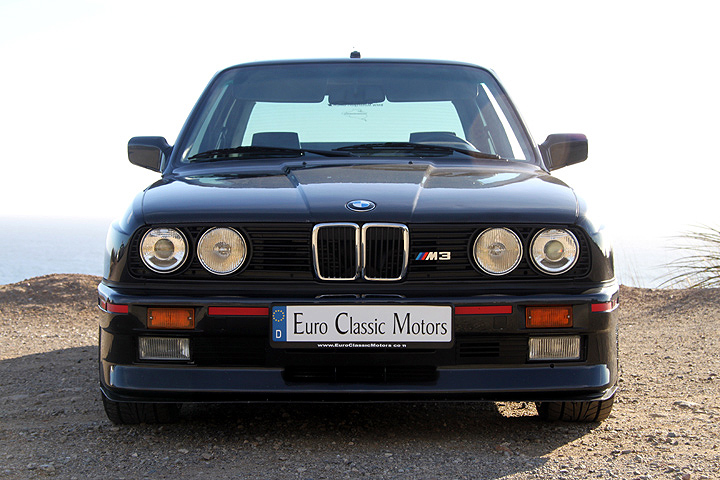
| BMW 1990 Model E30 ///M3 Diamond Shwartz paint code 181/9, Engine conversion S38-B36, 3.6 Sold from new in California, car with no rust. Euro Sport Evo Unique Cloth Interior including door panels Restored from bumper to bumper. VIN# WBSAK0311LAE33596 | ||
| This ad is for those who are interest in E30 M3 with engine conversion! | ||
| Please read my detailed description if you are serious about this car! If you are not enjoy the pictures. I know it’s too long but your question will be answered inside. | ||
| Please be patient until all pictures download | ||
About me: As a big
enthusiast of classic BMWs and Mercedes, I own and collect several cars
including: E24 M6's, E28 M5's, and two E30 M3's. My projects are all at
professional level. I am not a dealer in need to roll cars in order to
make money what so ever. The time and money I invest into my projects
are absolutely not worth it from the business point of view. It is all
about the passion!    |
||
| About my engine choice:
As we all know, the S14 is M88/3 engine is without the 2 cyl. In my
engine choice, I decided to use the S38 engine or I was going to stay
with the beloved S14. In my opinion, the S38 is the best choice. The
first prototype 24valve engine developed by "Engine Kind" Paul Rosche,
it was coded M49/1/2/3/4/5. These engines were designed for racing
not for street use. They were used to race the E9 batmobile, E26 M1
etc. Later coded M88/1/3, S38-B35, S38-B36, S38-B38. Later on BMW put
them into street cars and designed these unique sport character street
cars with racing engines E30 M3, E28 M5, E24 M635CSi, E34 M5. The S14,
S38 engines will remain in the BMW Motorsport history as the main
successor on the BMW world map of racing! Another benefit of the S38
engine is that they have more torque in any rpm range compared to other
BMW 6cyl engines such as Euro S50-B32(321hp), S54-B32(333/343hp),
US52-B32(240hp), S50-B30(286hp) etc. Also, the S38 has a lot of reserve
potential to increase power compared to other bmw S-inline sixes already
squeezed to is maximum from the factory. I absolutely respect the factory S14-B23/B25. It's the ultimate 4 cyl engine of all time! I drove it for few years and I really enjoyed the Factory engineering. As a kid I was inspired from the German performance company "Hartge" H35-24 M88/3, and Alpina, who produced about 6+/- E30 M3's with M88/3 Hartge, and M30-B35 Alpina. I can't imagine how fast those cars were back in the days. |
||
| What is the actual weight distribution? The true weight distribution of the real street factory E30 M3 is Front 51.0 and rear 49.0 depending on the car options. It's not exact exactly 50/50. I have measured few E30 M3's at my friends corner balance scale. After my S38 conversion, the weight distribution increased by only 2% at the front. That means 53.x% front and 47.x rear. This is with full interior, spare tire, full liquids, trunk tools, all carpets etc. For instance, my friend who owns a track toy Euro E30 323i with M30-B35 swap with complete strip down chassis and it has the distribution weight of, are you ready…. Sixty~60 % Front and Forty ~40% rear!!! He is absolutely able to keep up at Buttonwillow track with my other friend with E92 M3, and E46 M3 and some other high performance cars with 50/50 weight distribution. | ||
| How important is the weight distribution? Well, after the S38 conversion, the weight distribution is not bad at all! If your life is dependent on supporting your family, and your form of making money is racing exactly E30 M3, then I understand that purpose of keeping the S14. But I don't think such a thing exists. I out performed my friend's E30 M3 S14 powered in any circumstance. | ||
| Exterior: Diamond Swhartz Metallic BMW (paint code 181/9). The body is completely rust free with no damages. The car has been refinished to its original color using OEM "Glasurit" paint. I have pictures before I started the restoration. The car had the original factory paint! This car includes: all new rubber moldings, evo rear spoiler with adjustable flap, new euro head lights with clear bra protection, new oem yellow turn signals as well new smoked turn lenses. Also includes: all new oem emblems, new fog lights, new clear bra on all lights, and new front wind shield along with a new carbon fiber light weight hood. Xenon lights with day light bulbs operating as euro cars with combination of all lights available at one time! (not available for US market). Sport Evo aero dynamic seal on hood, rear bumper, front bumper and fenders. The car has been always garaged or if outside covered! | ||
| Interior: is with new original Sport Evo unique cloth interior, new m-techink emblems, new leather on steering wheel, shifter boot, and hand brake boot all include Tri-Color ///M stitching. New heater core, all new interior bulbs, cluster has been customized to match the accurate rpm's including new rpm graphic. The original S14 has never showed accurate rpm even with a changed chip. The trip miles are set from 0 after the completion of the S38 rebuild from the very first time I started the engine. The oil life green lights are in working order, "Check control" computer is clean with no warning lights, New ///M leather illuminated shift knob, new central electric lock module. Speakers work perfectly. Heater is in mint condition. AC is there and I can install the compressor and charge the system if desired and it will work perfectly, but from the performance point, I kept it out. Everything is working in the car with no exceptions. Euro front grill. New BMW glove box flash light. Extra power inside the glove box for anti radar or other electronic dividers. New heater valve. OBC computer is matched to show the correct MPG and the fuel to empty. That was very hard to match! Now it's like a factory car. Original E30 M3 Manuals included. | ||
| Drive train: is the legendary S38-B36 from E34 M5 Note ( for those who do not know, this is the second generation S38 found in E34 M5,the engine is NOT like on US E28 M5, E24 M6). The engine has been completely rebuilt with all new hard were, it is board to actual 3.6l. Note (originally is 3.5 ) The engine has 3.8 cam gears. I set them advancing the intake cam shaft and retarding the exhaust in order for better cylinder filling. The head is port and polished with matching headers and Intake trumpets horns. All new guides, valve seals, valve adjustment, new JE pistons with raised compression from 10.1 to 10.5. New bearings set, timing chain, guides, new factory timing chain tenssioner. Also I have the brand new S50 upgrade if needed but I like the factory better. This car also includes: new modified custom fan blade, new Beru ignition wires and cap@rotor. The intake filter was custom installed under the front bumper in order to breathe cold air (very similar like dinan e39 M5 cold air intake). Upgrade E32 740 brake booster , ABS unit has been relocated under the brake booster in order to open spaces for the intake. Custom engine brackets with using e36 m3 engine mounts. Upgraded cooling system from S38-B35 in order to save weight and advantage of using different thermostats. S38-B35 radiator, low temp auxiliary switch, Custom E24 windshield tank with filter , custom hose and wiring all work as factory. All new water hoses. Custom radiator support works in order to fit the water radiator and to look like factory set up, custom air shroud, and custom cold air intake is located behind the drivers' side fog light/bumper. Original diagnostic plug in working order. Car is dynoed with the TMS chip at 283rwhp and 260rwptorque that comes to 333hp at the engine. With the stock chip it pulls around 275rwhp. After the dyno, I installed a stronger fuel pump and it immediately felt much better after ! So there is few rwhp gain. | ||
| What transmission I chose? My choice is well known and bullet proof throughout years of the gearbox model: Getrag 260 model with 1st 3.83 ratio and 2nd 2.40ratio. They are shorter gear ratios for faster acceleration compared to M5 280 Getrag 1st 3.51ratio, 2nd 2.20ratio the rest 3rd 4th 5th are the same ratios. The tranny shift nice and tight. Gears do not grind, red line oil. New seal, no oil leaks. Very healthy tranny. New Sachs original clutch, single mass11 pounds fly wheel. I have 2 choices of differential current on the car: 3.73lsd and also cruising 2.93lsd if desired. Suspension is adjustable ground control, spring rate is 600 pounds front and 750 pounds rear with sport bilsteins. Stock brakes work very well for street fun. | ||
| Wheels: : BBS LM "style reps" Front 8J 225/35/18 rear is 9J 255/30/18. With these BBS wheels/tires, the car shows accurate cluster speed mph matched the Factory tire diameter! The car has been dynoed at "speedometer shop". | ||
| What kind of exhaust? Definitely one of my favorite parts! The exhaust is custom made by www.rennermotorsport.com Hand made Dual 2.5 inch starting from the headers made from U bends in order to keep the same diameter all the way to the magnaflow muffler 2.5 dual inlet and dual outlet with dual 3inch tips. Ceramic/metal cats! Note(I hate driving without cats polluting the air we breathe! For 5hp gain NO tanks I will keep them on the car). The car passes smog with flying numbers. I tested it already at a smog station. No resonators to save some weight. The engine flows amazingly. Yes, it's a little too loud according to my wife and all my neighbors ☺ but I love it. The sound from the S38 is very good with a deep sound similar to small v8 engines. | ||
| After I completed the project. After I finished the project I drove about 3000-4000k brake in miles with 1k-5k rpm range with few oil changes between. I was very careful to brake in the engine properly. There were no problems, no overheating, and no oil leaks! Nothing! It proves that everything is reliable and holds as a factory car! I have covered so far total of 14.xxx miles with absolutely no problems! | ||
| Let's find out how fast the car is?
Well, the car is definitely not as fast as C6 Z06 ! or anything like
that. Let's be real. In BMW world the car is fast! I did surprise lots
of E46 M3's, E39 M5, E39 540ietc. Also, I have a friend who has EVO IX
dynoed at 350rwp at all 4 wheels and we did rolling start form 40mph all
the way to 150mph and the cars were dead even. I was actually surprised
and pleased from my natural aspirated S38 engine AND my rear wing was
open! I forgot to close it and that was a big minus for me! We all know
how much drag the wing produces at high speed in order to keep down
force. So, if the flapper was closed it would be significantly faster. In general, the car is super fun and fast to drive and makes you smile. I made these few tests with my friend's cars just to see the final result out of E30 M3 with S38-B36 swap. This E30 M3 has never been tracked or abused. It's too nice to take to the track. For fun, I am building an E24 M6 turbo monster for a track toy so I can abuse it without worrying about damages, rock chips, etc. |
||
| About this S38-B36 project: As you can see from the pictures my goal was to make it as close as possible to the factory look. This project took approximately 2 years to complete. The car as you can see in the pictures is 100% done. Including complete restoration paint, engine custom work modifications, Interior etc. I spent more than 500 documented hours on this project! I got tired counting and dumped the book I used to record the hours. Not to mention counting the hours was worthless. To complete this precise job, time should not count! The quality of this car will show that this was NOT a 2 weekend S52 fast swap. | ||
| Why I am selling this beautiful car? I have my dream Euro engine coded S38-B38 I nick named it “The Ultimate S38 engine” and it will go into my second E30 M3 Diamond Shwartz and I will keep that car for life. According to BMW Motorsport factory “S38-B38 is the most powerful 6cyl engine BMW has ever produced ! It is originally 3.8 euro 340hp with 295torque as much as S65-B40”. I have a second car and this will be my garage toy for life. So I have another hobby project to keep me busy ☺. | ||
| What is the asking price? The car itself, engine S38, euro Evo cloth interior, with complete body restoration, custom work, tons of parts, and including the fact that I spent so much time (+500hours) and money on this project, the investments exceed more than +45k $. I am offering this car for the low price of $29,785. Offers are accepted near/by the asking price. If you think my price is actually as much as a very clean E46 M3 with super low miles, it is true, BUT, my opinion is that this E30 M3 is a lot more rare, unique and fun to drive compared to some regular E46 M3 seen on every corner and stop light. Not to mention it will hold its value and increase in value. This car is a turn key, fill 91 gas and enjoy. You will not be disappointed from my car! | ||
| Title is California and in my possession. It is a clear title, NOT salvage, no accidents. CarFax does not show correct miles from the 90's. Chassis has around 168k miles. All fresh S38-B36 has 14.768 miles. | ||
| Here is a list of parts I have changed with part number. As you can see from the pictures my goal was to make it as close as possible to the factory look. This project took approximately 2 years to complete. The car as you can see in the pictures is 100% done. Including complete restoration paint, engine custom work modifications, Interior etc. I spent more than 500 documented hours on this project! I got tired counting and dumped the book I used to record the hours. Not to mention counting the hours was worthless. To complete this precise job, time should not count! The quality of this car will show that this was NOT a 2 weekend S52 fast swap. | ||
| My contact information is 323.702.XXXX Source: http://www.euroclassicmotors.com/galleries/E30M3.html |
Sunday, August 19, 2012

Sunday, August 12, 2012
Engine Build
Amazing possibilities exist for the e30
http://forums.bimmerforums.com/forum/showthread.php?t=1715145&highlight=m50+stroker
http://forums.bimmerforums.com/forum/showthread.php?t=1715145&highlight=m50+stroker
Saturday, February 18, 2012

Saturday, February 11, 2012
"wear metals"
over on the forums there was a conversation regarding oil sampling, metallic wear and oil analysis...
seriously, say you have a large investment in a race motor ($50k+-). you wouldn't just wait till it blows up. maybe your running full systhetic oil and want to take advantage of extended drain schedule. analysis would tell you when it's time to dump it or even to just change the fillter.
here are some of the "wear metals" in a car engine that end up in the oil when wear is occuring...
Iron (Fe) Cylinder Liners, Rings, Gears, Crankshaft, Camshaft, Valve Train, Oil Pump Gear
Chrome (Cr) Rings, Liners, Exhaust Valves, Shaft Plating
Aluminum (Al) Pistons, Thrust Bearings, Turbo Bearings, Main Bearings
Nickel (Ni) Valve Plating, Steel Alloy from Crankshaft, Camshaft
Copper (Cu) Lube Coolers, Main and Rod Bearings, Bushings, Turbo Bearings
Lead (Pb) Main and Rod Bearings,
Tin (Sn) Piston Flashing, Bearing Overlay, Bronze Alloy, Babbit Metal
Silver (Ag) Wrist Pin Bushings
oh yeah, and he asked "What is the best way to tell if your engine bearings are going bad?" pending was my word.
seriously, say you have a large investment in a race motor ($50k+-). you wouldn't just wait till it blows up. maybe your running full systhetic oil and want to take advantage of extended drain schedule. analysis would tell you when it's time to dump it or even to just change the fillter.
here are some of the "wear metals" in a car engine that end up in the oil when wear is occuring...
Iron (Fe) Cylinder Liners, Rings, Gears, Crankshaft, Camshaft, Valve Train, Oil Pump Gear
Chrome (Cr) Rings, Liners, Exhaust Valves, Shaft Plating
Aluminum (Al) Pistons, Thrust Bearings, Turbo Bearings, Main Bearings
Nickel (Ni) Valve Plating, Steel Alloy from Crankshaft, Camshaft
Copper (Cu) Lube Coolers, Main and Rod Bearings, Bushings, Turbo Bearings
Lead (Pb) Main and Rod Bearings,
Tin (Sn) Piston Flashing, Bearing Overlay, Bronze Alloy, Babbit Metal
Silver (Ag) Wrist Pin Bushings
oh yeah, and he asked "What is the best way to tell if your engine bearings are going bad?" pending was my word.
Saturday, February 4, 2012


Thursday, January 26, 2012


Wednesday, January 4, 2012
engine - korman rebuilt m10 products options/versions
Korman Stage 1 Rebuild-CIS M10 2.0 Liter 1977-1979
The early (77-79) 320i engine responds dramatically to Stage 1 tuning, with up to 135 HP from 110 HP stock. We also include our performance distributor to replace the original.
P/N 110B2110
Korman Stage 1 Rebuild-CIS M10 1.8 Liter 1980-1983 320i
The 80> 320i models come with a 1.8 liter engine. Our Stage 1 performance rebuild on these models includes a 2.0 liter conversions. Special fuel injection tuning is required and included. We reuse the original electronic ignition system but include a special Korman-Stahl header. Torque gains are substantial, and combined with the 3.91 gearing of the 1.8 liter cars provides that acceleration "punch" lacking in the original.
P/N 110B2180
Korman Stage 2 2.0 liter engines
150 HP, revs to 7000 RPM. Dual Weber 40 DCOE's, Korman intake manifold, Stage 2 porting and polishing, high compression pistons, lightened rods, Korman K300 cam, dual valve springs, chrome alloy retainers, Korman rocker arms, mechanical advance distributor, Korman-Stahl headers. Also available with Schrick 292 cam, (160 HP), or Weber 32/36 carb (140 HP).
Call with your specific application for pricing.
Korman Stage 2 2.0 liter Competition Engine
Our hot autocross/rally engine. Many BMW enthusiasts use this engine for regular street driving since it is surprisingly tractable and well behaved in city traffic. But it is a light competition engine and built for power. Don't expect 150,000 miles at 7500RPM, but it is designed to operate at that engine speed. This 170 HP engine includes the Schrick 316 cam, two twin 45 DCOE Webers, lightweight connecting rods, high compression pistons, titanium valve spring retainers, racing headers, etc. Blueprinted to competition specifications.
P/N 11002330
Stage 3 2.2 liter Competition Engines
This engine utilizes a special knife edged crankshaft, lightweight connecting rods, custom pistons, Schrick 316 cam, dual Weber 45 DCOE's, etc. Produces 200 horsepower in this configuration (others available). Don't forget bigger brakes! Call for pricing.
6 Cylinder (M20) Engines 2.0, 2.3 Liters for 320/6 and 323i
From stock to full race, we can provide a strong small six engine for your E21 built to your specifications. Call for pricing.
Source - http://www.kormanfastbmw.com/e21.htm
For the builders: http://strikeengine.com/header-manifold-design
Thursday, November 17, 2011
Tuesday, October 18, 2011


Tuesday, September 27, 2011

Subscribe to:
Posts (Atom)