...the journey of a '77 bmw 320i from its home in california through a mild "frame on" restoration in the midwest...
Monday, March 21, 2011
Sunday, March 20, 2011
This is the 'unrestored' rear sub frame of my e21...notice that the camber & toe adjusters have been welded on, the subframe has not been sandblasted or repainted
This is the freshly painted 323i trailing arm replacing the original 320i trailing arm.
![]() |
| NOTE: The only reason to use the 323i trailing arms is for rear disc brakes!!! |
the underside of the original subframe, after sandblasted, primed, and painted.
I bought a 3 point cylinder hone at harbor freight and honed the inside of all cylinders for urethane bushings, and bearings, and races.
the urethane bushings fitted into the 323i trailing arms and bolted into the channels on the subframe.
expanded view of the urethane bushings, pressed into the trailing arms, and bolted into place, fitted into the channels on the subframe.
it was getting late on a sunday night...sorry for the poor quality pictures...
Saturday, March 19, 2011
Front & Rear Struts, Springs, and Shocks
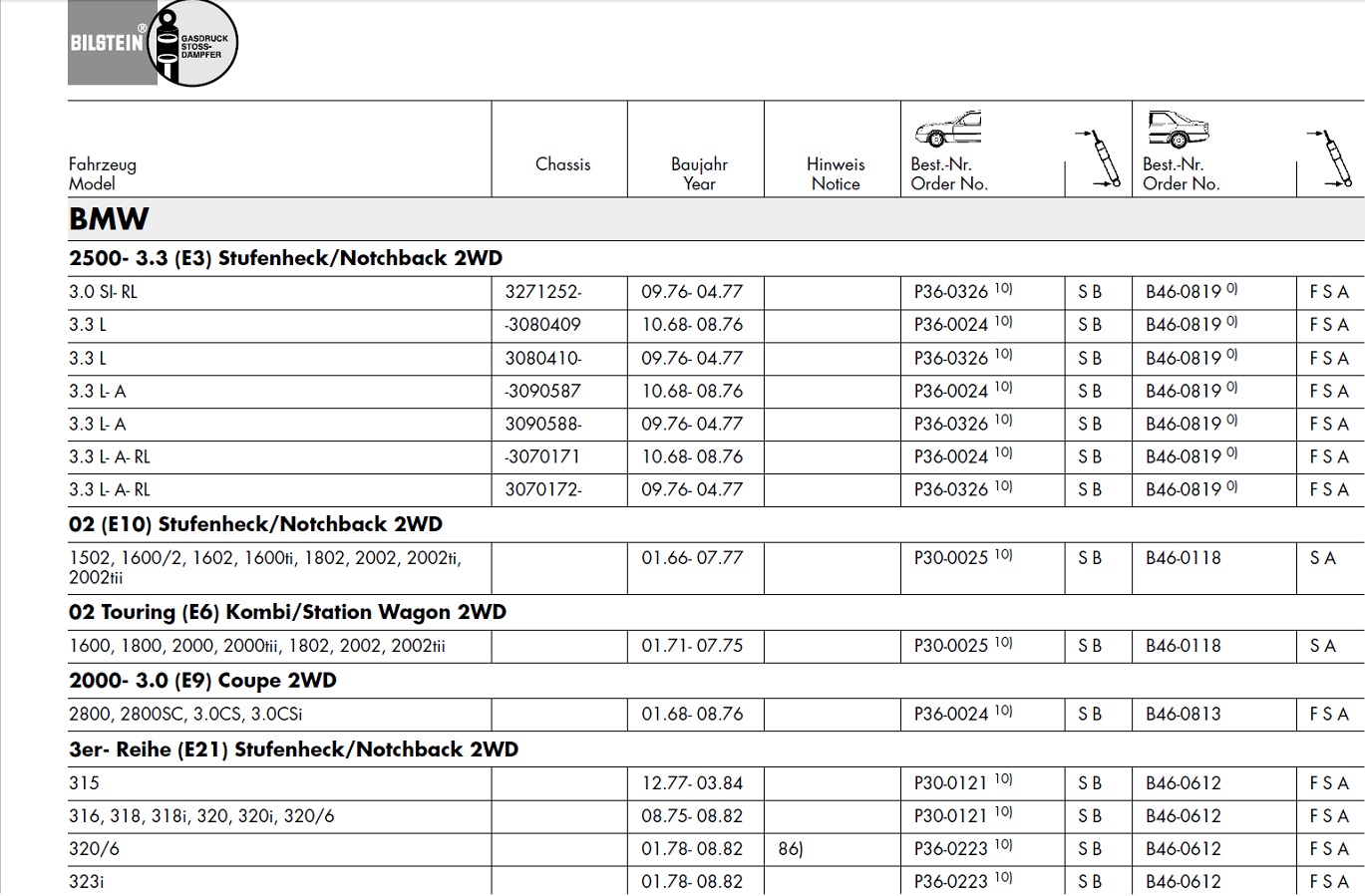
Even though 323 sports are NO LONGER AVAILABLE, Bilstein does have the dimensions. Ask them to compare the e21 323 size with the e30 6cyl/m3 size, SSDD
Early (77-79)
31321115398 (BOGE)
31321130068 (BILSTEIN) <--- Has a different Bilstein part #
Late (80-83)
31321123901 (BOGE)
31321126275 (BILSTEIN) <--- Has a different Bilstein part #
Part # for a post-80s bilstein gland nut is B30-629 F1
Bilstein Sport Dampners
Front: P30-0125-H1
Rear: B46-0617-H0
Bilstein Heavy Duty Dampners
Front: P30-0121-H1
Rear: B46-0612-H0
323i Specific (any year)
Bilstein Heavy Duty Dampners
Front: P36-0223-H0
Rear B46-0612-H0
Gland Nuts M48 x 1.5
31321117376 (BOGE)
31321130069 (BILSTEIN) <--- Has a different Bilstein part #
AFTERMARKET & MOTORSPORTS
HEADQUARTERS - WEST
14102 Stowe Drive
Poway, CA. 92064
1-858-386-5900
http://www.bilsteinus.com/
Source: http://www.autosportgallery.com/305-%209-09applicationguide.pdf
When considering which shock to buy for an E21..consider the following between Sport/HD shocks...suspension works both ways (up and down), static sag is an important consideration.
if a billie sport has 115mm of travel then i would try to get 25-30% of static sag, or 32mm. then you still need to check the compression and make sure there is enough travel for bump.
the best way to do this is with a zip tie around the shock's shaft. with the car lifted tie a zip tie and slide it down onto the top of the shock, put the car down on it's wheels and then lift the car back up and measure the distance between the shock and the zip, that's the static sag.
take the car for a spin putting it hard into a corner or two. lift the car and measure the distance from the shock to the zip, this is the total shock travel. deduct the sag measurement and you have the amount of 'used' bump travel.
if the total used travel is as much or close to the length of the shock travel (115mm for billie sport) then you need stiffer springs. if the static sag is too little then softer springs are required.
the above is just a basic outline, but it gives you a good idea of what the suspension is doing. this is how we setup motorcycles where the results are much more critical than a car.
Product Name: Bilstein B6 Sport shocks VA BMW 323i E21 51mm Strut
Axis: 2 shocks for the front
Design: B6 Sport
Model: P36-0223
The early/late model e21 320i 4cyl model share the same front strut inserts, only the gland nut is different. The e21 323i uses a different setup altogether. Since Bilstein no longer makes Front Sport Strut inserts for the E21 323i, and if you want to use the E21 320i Bilstein Sport inserts on the 323i strut housing, then you would need the following gland nut from Bilstein--Bilstein P/N: B4-B30-U232A1.
The 323i front strut housing has a 36mm piston diameter. The 320i strut insert has a 30mm piston diameter. So, you need a male gland nut that has an inner diameter of 30 mm and a outer diameter of 36mm.
320i 45mm strut od, uses a 38mm insert (shock) which has a piston size 30mm
323 51mm strut, uses a 45mm insert, and has piston size of 36mm.
This is what Metric Motorsport said about building coil overs: "We use revalved VW Rabbit gti sport fronts, they are shorter, to maintain travel after lowering.The rabbit struts are from 1983 VW gti. As for spring rates, 350/275 is usually what we ship our coil overs with for street applications. I have 450/325 in my E21, But I have a S52.. I would say 375/300 should be a good place to start. the fronts should be around 100 LBS stiffer then the rears."
__________________
Gland nuts M45 x 1.5 (Secures the sturt insert inside the strut housing).
Early (77-79)
31321115398 (BOGE)
31321130068 (BILSTEIN) <--- Has a different Bilstein part #
Late (80-83)
31321123901 (BOGE)
31321126275 (BILSTEIN) <--- Has a different Bilstein part #
Part # for a post-80s bilstein gland nut is B30-629 F1
Bilstein Sport Dampners
Front: P30-0125-H1
Rear: B46-0617-H0
Bilstein Heavy Duty Dampners
Front: P30-0121-H1
Rear: B46-0612-H0
323i Specific (any year)
Bilstein Heavy Duty Dampners
Front: P36-0223-H0
Rear B46-0612-H0
Gland Nuts M48 x 1.5
31321117376 (BOGE)
31321130069 (BILSTEIN) <--- Has a different Bilstein part #
AFTERMARKET & MOTORSPORTS
HEADQUARTERS - WEST
14102 Stowe Drive
Poway, CA. 92064
1-858-386-5900
http://www.bilsteinus.com/
Source: http://www.autosportgallery.com/305-%209-09applicationguide.pdf
When considering which shock to buy for an E21..consider the following between Sport/HD shocks...suspension works both ways (up and down), static sag is an important consideration.
if a billie sport has 115mm of travel then i would try to get 25-30% of static sag, or 32mm. then you still need to check the compression and make sure there is enough travel for bump.
the best way to do this is with a zip tie around the shock's shaft. with the car lifted tie a zip tie and slide it down onto the top of the shock, put the car down on it's wheels and then lift the car back up and measure the distance between the shock and the zip, that's the static sag.
take the car for a spin putting it hard into a corner or two. lift the car and measure the distance from the shock to the zip, this is the total shock travel. deduct the sag measurement and you have the amount of 'used' bump travel.
if the total used travel is as much or close to the length of the shock travel (115mm for billie sport) then you need stiffer springs. if the static sag is too little then softer springs are required.
the above is just a basic outline, but it gives you a good idea of what the suspension is doing. this is how we setup motorcycles where the results are much more critical than a car.
Spring Rate vs Wheel Rate
Spring rate is the amount of force it takes to compress a spring 1-inch. Wheel rate is the spring rate actually measured at the wheel. Both are expressed in lb/in.
In order to calculate wheel rate, you need to know the spring rate, the motion ratio and the spring angle, as shown above. Then you can solve the following equation.
If coilover springs are installed (shown left side, above) the spring is moved close to the wheel, the motion ratio becomes about 0.95, and the wheel rate is about 0.90 x the spring rate. A much lighter 167 lb/in spring produces the same 150 lb/in wheel rate.
The chart below provides motion ratios and wheel rate factors that can be used to calculate an approximate wheel rate for a spring installed on a 1979-2004 Mustang. To obtain the wheel rate, multiply the spring rate by the factor that corresponds to the spring type and position on the car (stock or coilover, front or rear).
| 1979-2004 Mustang | Front | Rear | ||
| Spring Type | Stock | Coilover | Stock | Coilover |
| Motion Ratio | 0.50 | 0.95 | 0.70 | 1.05 |
| Wheel Rate Factor | 0.25 | 0.90 | 0.49 | 1.10 |
Note: These numbers are approximations and this discussion omits some variables in the interest of simplicity.
What you have to do is first measure your suspension and weigh your corners. Get D1 and D2, spring angle (this is the angle of the shock to the lower control arm) and the coner weights from individual scales. Then pick a spring, this will be a ballpark spring rate.
Motion ratio = D1/D2
(motion ratio^2 x ballpark spring rate) x sine(spring angle) = wheel rate
"You want your wheel rate to be about 1/2 the unsprung corner weight at the corner. The unsprung weight is the corner weight minus the wheel, tire, brake system, hub (upright), coilover lower mount and 1/2 the lower control arm.
First: it should be clear at this point that there is a boatload of research that goes into suspension design. Use other people's efforts who have gone before you and buy at the very least "Competitiong Car Suspension" by Allan Staniforth and "Engineering to Win" by Carroll Smith. If you really want to know what's going on and you want to do all the math then buy "Race Car Vehicle Dynamics" by Milliken and Milliken, it's published by the SAE.
Secondly: what might not be so obvious is your new $300 camber plates just allowed you to change your spring angle, which changes your motion ratio and effectively makes your springs "softer" for a given spring rate. This is another reason you can't take someone elses spring rates and have them work directly for you.
Thirdly: That stiffer roll bar you just installed, yup, it changes your spring rate too.
Your spring rate is the amount of distance the spring compresses at a given weight. If you have a spring that compresses 1" with a weight of 250 lbs then it's a 250lbs/inch spring. If installed at the center of the wheel at 90 degree (impossible but makes the math easy) then the suspension spring rate is 250lbs/inch. If you add an anti roll bar then in roll it exerts a force from one corner to the other which increases the effective weight that the suspension can resist per inch.
Sorry if this is odd sounding I'm on a phone and can't read what I wrote.
Think of it this way. If you have a bar, and it is one half of an anti roll bar, so it's a big L and it's connected to the suspension of one side like an anti roll bar but rather than held in a bushing on the chassis it's welded to the chassis then it will also resist suspension movement, It will act sort of like a big butterfly clip on it's side. It's just a different way to build a spring. In the case of the anti roll bar however it doesn't resist suspension movement if the other wheel is moving in the exact same way. So if you go over a curb with one wheel then the other wheel being connected resists the curb wheel's action. However if you go over a speed bump the anti roll bar doesn't really resist movement at all because both wheels are moving together.
--This is one reason you see big anti roll bars on luxury cars, you can get away with much lighter springs and still deal with road irregularities if you have a beefy anti roll bar. This makes the ride softer when you are just lumbering along on smooth roads or on the freeway.
--This is also why you see such small anti roll bars on F1 cars. They run such heavy springs that chassis flex and pneumatic tire deformation happens before the spring compresses, so anti roll bars don't really add much." ~ milotrain
Source: http://www.miracerros.com/mustang/t_wheel_rate.htm
Friday, March 18, 2011
Wilwood vs. Volvo/Girling front brake upgrades
|
| |||||||
http://www.wilwood.com/Calipers/CaliperProdP2.aspx?itemno=120-8729
http://www.wilwood.com/Calipers/CaliperList.aspx?subname=Powerlite
The stock 320i rotor diameter (vented and unvented) is 255mm. The volvo caliper (a cast iron girling 4 piston) would fit perfect on the e21 with no modification using a 276mm rotor. There is a larger off the shelf rotor that will work. The mini cooper uses a larger 276mm vented rotor (compared to 255mm 323i rotor) that fits but the rotor hat is shorter. the Volvo 240 4 piston girlings sat on 263mm rotors.
Above: You can run 276mm new mini (2003+) rotors which are 21mm larger than the stock 255mm 323i rotors. The rotor height is 44mm, thickness is 21.9mm, and the hub bore is 64.1mm (compared to 63mm for the e21 hub bore) so you'll have to use hub centric spacer rings to center the rotor on the hub. You may also want to drill the rotor for the hold down bolt. In this picture you can see the gap between hub and disc center bore and a new hole for the hold down bolt:
Above: The caliper has to be mounted on the outside of the mount ears rather than the inside. This will make the caliper difficult to bolt on since the rotor will be in the way. You will have to "walk" the caliper and rotor down into position as you tighten the bolts. Another option would be to drill out the strut threads and use a longer bolt and locking nut behind the rotor. J.K.jr.bad recommends seperating the caliper halves, attach the inside half, install the rotor, then bolt the other caliper half on. I would never do that on my car simply for the brake fluid mess. Before you buy mini rotors, bolt your calipers on and verify you have wheel clearance.
The Volvo/Girling front brake upgrade is the biggest bang for the buck in E21 brakes. But as you can see in the photo above, the Vovlo/Girling calipers have 2 hydraulic lines, in the photo above the installer utilized a brake line splitter. The preferred solution to this problem is utilizing an E12 master cylinder. This allows you to run the stock 320i vented rotors without the price tag of upgrading to the 323i vented calipers. For much less than stock 323i calipers you can get 4 piston calipers with about 30% more pad area.
According to parts suppliers, calipers off of ANY volvo 200 series car (240, 240 turbo, 242, 244, 245, 264) from 1975 to 1991 with vented rotors will work. Some of the earlier cars used ATE calipers which are interchangable with the girling calipers. Parts suppliers no longer carry the ate calipers so you'll get girlings (more common) anyway.
Here's the volvo naming convention:
1975-1979: three digits (in the format 2XY, where X represents the number of cylinders and Y represents the doors: 2 for coupés, 4 for sedans, 5 for station wagons)
1980-1985: trim level letters (the three digits were omitted in North American market)
1986-1993: 240 followed by trim level letters (third digit no longer reflected body style)
The cheapest deal on rebuild calipers I've seen is on rockauto.com.
Parts List:
Left Girling Caliper '75-'91 Volvo 240 w/Vented Front Rotors - Volvo P/N 5002028
Right Girling Caliper '75-'91 Volvo 240 w/Vented Front Rotors - Volvo P/N 5002029
Autohaus Part Number: W0133-1659892
The Volvo/Girling Product (the most bang for my bucks!)
http://www.autohausaz.com/search/product.aspx?sid=utryjh2lrbubal550vekqqmf&makeid=27@Volvo&modelid=768~20~914~34~~5~7@240%20%20&year=1990&cid=3@Brake&gid=1704@Disc%20Brake%20Caliper
'77 320i vented rotors (or 323i rotors from any year - same part number)
(4) m12 or 7/16" washers, 1.5 mm to 2.5mm thick
(2) Metric Brake Line Tee - Jbugs.com
(2) M6 x 1 x 1 bolt (to mount tee to strut)
(2) 10" or shorter metric brake line - M10x1.0 tube nut fittings and bubble flares (from braided line to tee, cut to fit)
(4) 14" metric brake line - M10x1.0 tube nut fittings and bubble flares (from tee to calipers)
Brake Pads - for a hi performance street pad you can run the Hawk HPS
Tools needed:
tin snips (to trim the backing plate)
dremel tool/die grinder & carbide bit (to slot holes in calipers)
Brake line tubing cutter
Brake line flare tool
a day with jonathan at the junk yard in aliquippa
10/82 320i
10/82 320i
10/82 320i
AG3302D 8389807
OEM Parts Diagrams for this VIN
Out of the Back of a 635csi (free)
the 635 csi also has a complete rear interior kit...speakers, rear side cards, and rear seat moldings...to be disassembled next week $25.00 total
Off the 10/82 320i $25/ea.
10/82 320i
10/82 320i
AG3302D 8389807
OEM Parts Diagrams for this VIN
Out of the Back of a 635csi (free)
the 635 csi also has a complete rear interior kit...speakers, rear side cards, and rear seat moldings...to be disassembled next week $25.00 total
Off the 10/82 320i $25/ea.
Rear Wheel Bearing: SKF BB1M30 362525 (30X58X16)
Rear Wheel Bearing BMW Part Number: 33411119994 (Number 5 in the diagram)
- Bearing Brand: SKF BB1M30 362525 (30X58X16) GROOVED BALL BEARING
Rear Wheel Bearing BMW Part Number: 33411122131 (Number 6 in the diagram)
- Bearing Brand: FA3 6206.c3 (30X62X16) GROOVED BALL BEARING
Subscribe to:
Posts (Atom)