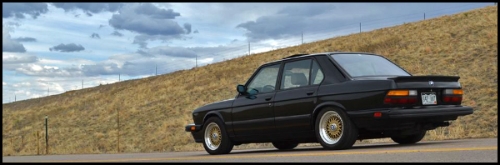
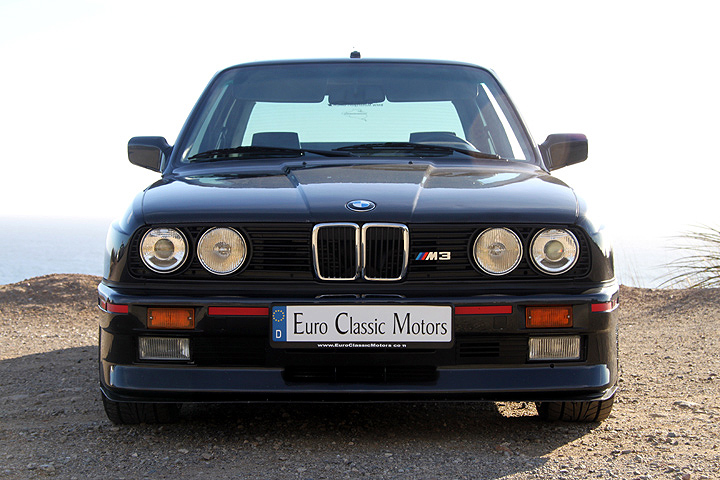
The History of the S38 engine
This
article goes a bit deeper into the engine of our beloved E34 ///M5.
Like you may have heard or read before, this engine is the result of an
almost 20 year evolution of engine development at BMW ///M GmbH. But
let's go a bit further into detail about its history. The intention of
the article is not to explain the technical differences, but to give an
overview of the evolution and to describe the legacy of the S38 engine.
It
all started in 1973 when BMW needed a more powerful engine for the
competition CSL's to compete with the Ford Capri's. Until then, BMW via
Schnitzer and Alpina raced the CSL's with the M38 and M52 engines. These
SOHC engines where based on the M06 engine from 1968. The M06 is the
first version of the legendary engine family, which we all now know as
the M30 big six.
Linking the M30 with the M06 may seem
confusing, but it is not. In the early 1980's, BMW switched to a new
system of coding their engines. Before then, an engine was designated by
a three character long code and if applicable followed by a version
(for example M90 or M49/1). The new engine coding used a six character
long code and if applicable followed by one or more characters for
engine specifics. The new engine code allowed BMW to specify its source
(regular BMW or BMW Motorsport), the engine family and the displacement.
Examples of the new engine codex are M30B35 and S62B50. The M06 engine
from 1968 is coded according to the old coding system, while the M30B35
from 1985 is coded according to the new system. Some common engines with
an 'old' ID code also received 'new' engine code. For instance the M06
is also know as the M30B25V with the V meaning "Vergasser" or
Carburettor.
The M52 racing engine family created a base for the
new 24-valve race engine coded M49. This new engine was developed by a
new division lead by Jochen Neerpasch. Today we know that division as
BMW Motorsport. Jochen Neerpasch managed to create a team with amongst
others Paul Rosche, also known as "nocken Paul". The cylinder head of
the M49 engine is almost similar to the M12/2 formula II engine. This
means that the camshafts are driven by directly by gear train. This
valve-train was driven by a single timing chain via an intermediate
shaft. Theoretically this allowed the head to rev over 9000RPM. But
since the crankshaft is larger than the four-cylinder Formula II engine,
9000RPM was the limit for the group 5 engine. The M49 equipped E9 CSL
won it's first race in the European ETC series on the Salzburgrung in
March 1974. A remarkable success, especially because it was also it's
racing debut. The oil crisis of 1973 and the commercial lack of interest
for high performance cars (the E20 2002 turbo being a good example)
slowed down the development of the E9 CSLs. Four E9 CSLs with M49
engines entered the American IMSA series in 1975. Also in 1976, BMW
participated in the American IMSA series. During these two years, BMW
won 7 races.
In Europe, there was hardly any real competition
and when plans for a group 5 class for the 1975 season did not
materialize, the European E9 CSL's with M49 engines where sold of.
Alpina bought at least one and about two years ago one of these cars
showed up for sale in the Netherlands for about US$25000.
For
the 1976 season, the oil crises was a few years back and BMW decided to
enter the newly created group 5 series. By request of the factory, Josef
Schnitzer further developed the M49 engine so it could be used for
vertical installation in the CSL's engine bay. Vertical installation
allowed the use of larger exhaust headers, a more optimized inlet system
and the installation of a more efficient cooling system. This engine
was named M49/3 and yielded 465hp @ 8500RPM. But compared top the
Porsche 935 turbo, the E9 CSL with the atmospheric M49/3 engine did not
have a chance to compete. That is why in a later stage, twin turbo
chargers where added. This was the fifth evolution of the M49 engine and
was called M49/4. The M49/4 had a 300cc smaller displacement. With a
bore of 94.0mm, the M49/3 only had 6.0 mm gap between the cylinders. For
the non-turbo charged engines, this was enough, but turbo-charged
engines produce much more heat, which has to be removed efficiently.
Reducing the bore is one of the ways to achieve this. Even today,
reducing the bore is a common practice to create a larger gap between
the cylinder walls to create larger cooling channels within turbo
charged engines. The four-valve M49/4 engine allowed a relatively low
turbo pressure. Usually, a boost of 1.3bar (18PSI) was used to yield a
neat 750hp @ 9000RPM. This high power output came with a relatively high
reliability of the engine. Although the CSL gearbox was not designed
for such a power, it held up rather well during the races. The practical
experiences with the M49/4 engine provided a basis for the development
of the later E26 ///M1.
All in all, the M49 engine and the E9
CSL where very successful in the Group 2 European Touring Car (ETC)
series. From 1973-1976, BMW won the championship in these series.
Although the last CSLs where made in 1974 and the last E9 coupe's left
the factory in December 1975, BMW Motorsport continued to support it in
1976, but could continue that in 1977 because it was an obsolete model.
This was a logic consequence of the introduction of the E24 6 series and
using the CSL longer would not benefit the sales of the new coupe.
Private teams continued to use the E9 CSL until 1978 and even managed to
win the European Touring car Championship (ETC in 1977 and 1978. The
following table shows an overview of the M49 engines which where used in
racing.
Table 1, M49 engine family
For
the group 5 series, Jochen Neerpasch wanted a mid engined racing car.
The development of the E26 ///M1 started in 1976. The idea was to
develop a racecar first and a road car second. Since BMW did not have
the capacity or the expertise to build a tube framed car, BMW Motorsport
contacted Lamborghini to help with the development and the production
of the chassis. But Lamborghini came into financial troubles and was not
able to fulfill its commitments to BMW. This delayed the production of
the E26 ///M1 with more than a year and by the time the production of
the ///M1 started, the rules for the group 5 touring car championship
where changed and ruled out mid engined sports cars. At that time,
Jochen Neerpasch had his new racecar, but could not use it. Max Mosley
of the FIA came up with a brilliant idea. A new race class was
established specially for the ///M1. This new race class, the Group 4
Pro Car series was scheduled to take place before a Formula 1 race with a
few formula 1 drivers and privateers.
The engine for the ///M1
was an evolution of the M49 engine of which the development stopped in
1977. However the new M88 had significant changes to allow it to be used
as a production engine for road cars. The same changes were made when
building the E26 ///M1 for sale as a road car, a requirement for the
group 4 regulations. The Group 4 rules required that 400 units of that
same car would be made within one year. The direct drive of the
camshafts by a gear train was abandoned for a direct chain drive to
reduce the interior noise. Like the M49, the M88 engine also used a
Kugelfisher mechanical fuel injection system. The cylinder head of the
M88 consisted of two pieces. The lower piece contained the intake and
exhaust ports, the valves and the spark plugs. The upper piece contains
the buckets, shims, camshafts and bearings
Compared to the M49/3,
the M88 had a slightly smaller displacement (3453cc). This was achieved
by reducing the bore slightly to 93.4mm. However the stroke of the
engine remained the same (84,0mm). To test if the M88 engine would be
reliable for a production engine, BMW placed the existing SOHC drive
train on the M88 cylinder block. This engine, called M90 used a regular
Bosch L-Jetronic (predecessor of the Motronic) fuel injection system and
yielded 218hp.
The road going ///M1 used the M88 engine. The
M88 yields 277hp @ 6500RPM and 330nm @ 5500RPM. This was more then
enough to propel the 1418kg sports car in a little more than 20sec to
the 200km/h mark.
Since the E26 ///M1 was designed for racing
first, the M88 engine was heavily modified. For road use, the M88 is
tuned to offer a good compromise between tractability, engine longevity
and performance. Engine longevity is not that important for racing and
for group 4 and 5 Procar races a lot more than 277hp was required. New
camshafts, larger valves, reshaped ports, throttle slides instead of
butterflies, forged pistons and a completely different exhaust system
helped to increase the power to almost 500bhp. For Group 5 purposes, two
turbo chargers where added. This version is known as the M88/2.
Depending on the boost pressure, the power output was between 850bhp and
950bhp.
Table 2, M88 engine family
With the
cease of the group 4 and group 5 races, BMW stopped to use the M88
engine for racing purposes and concentrated on developing race cars on
basis of the E21 and later the E30 3 series. But in 1983, the M88 was
used one more time to power the new top model of BMW, the E24
///M635CSI. The regular 635CSI lacked the power to compete with
Porsche's 928S and the Mercedes 500SEC. For the E24 ///M635CSI, the M88
was redesigned. The bore and stroke of the M88/3 engine remained the
same as the M88. Also six individual butterfly valves where used for the
M88/3. However, Bosch's Motronic, the first digital controlled
fuel-management system that was used in production cars, replaced the
M88's Kugelfisher fuel injection system. This allowed the compression
ratio to rise to 10.5:1. Thanks to these changes, the power output rose
to 286hp at 6500RPM. The torque rose slightly also to 340nm at 4500RPM.
This was 500RPM lower than for the original M88 engine and this helped
to improve the M88/3 abilities for daily use.
At the end of
1984, the M88/3 engine was also fitted in the E28 5 series. Unlike the
///M635CSI, the E28 version was not named ///M535I as this type was
already given to another E28 with the M30B35 engine. Instead, the name
///M5 was chosen. Already from September 1984 till February 1985, a
small number of E28 ///M5's where hand build by BMW Motorsport for a
happy few. It was not before February 1985 before the E28 ///M5 was
introduced to the public. In the mid eighties, unleaded fuel and the use
of catalytic converters became more and more common in Western Europe,
especially in the environment oriented Swiss and Austrian market's. The
M88/3 engine did not have a catalyst. BMW did not want to be accused of
being insensitive to the environment and decided against the
introduction of the E28 ///M5 at the important Geneva car show. Instead,
BMW released the E28 ///M5 at the Amsterdam car-show, reducing the
potential risk of bad environmental publicity in the widerinternational
press.
Despite that BMW already switched to a new engine codex
in 1983, the new 24-valve engine kept the family code M88. It was not
before 1986 when the S38 designation was used for the catalyst version
of the M88/3. The S38 stands for, 'S' means that the engine is
originated by BMW Motorsport, the '3' means that it is derived from the
M30 engine family and last but not least, the '8' is chosen to make a
reference to the legendary M88.
During the mid eighties, the
///M635CSI and the E28 ///M5 where only available in Western Europe. In
the United States, there was a small but significant demand for these
'European only' cars. This gap in the United States market was served by
'gray market' importing companies. Realising this, BMW North America
introduced Motorsport versions of the E24 and E28 in 1987, but their
specifications where changed to meet the demands of the American market.
To meet US exhaust emission regulations of that time, the catalyst
equipped S38B35 replaced the M88/3. The S38B35 kept the M88/3s bore,
stroke and cylinder head, but to install a catalytic converter, the
compression ratio decreased from 10.5:1 to 9.8:1. The equally tuned
exhaust headers of the M88/3 where replaced by log headers. Al these
changes decreased the engine performance. The S38B35 delivered 260hp and
a torque of 330nm (243lb/ft) at 4500RPM. The US E28 ///M5 and E24 ///M6
also had more options fitted, many of which in Europe could only be
bought by special order. As a result, the US cars where noticeable
heavier than the European cars and this had an impact to the cars
performance. The European E28 ///M5 can do the 0-100km/h (0-62mp/h)
sprint in just 6.5sec, while the US version needs 0.3sec more.
For
the US and Japanese markets, The ///M635CSI was renamed to ///M6, while
in Europe the ///M635CSI designation remained. The distinction between
the ///M6 and ///M635CSI is the engine. The ///M6 always contains the
S38B35 engine, while the ///M635CSI can have both. Despite the catalyst,
the majority of the E28 ///M5s and E24 ///M635CSI in Europe where
equipped with the M88/3 engine, thus no catalyst.
The production
of the last E28s ceased at the end of 1987 after which the E34 succeed
it. It was without any doubt that soon after the introduction of the
E34, also a Motorsport version became available. The E34 ///M5 was
available for the German market in September 1988. The engine which
powered the E34 ///M5 is a further evolution of the S38B35 engine which
powered the catalyst versions of both the E28 ///M5 and E24 ///M635CSI.
The E24 ///M635CSI remained in production until its demise in spring
1989. During that time, the M88/3 and S38B35 engine where by BMW
Motorsport alongside the S38B36. This was of benefit for the last E24
///M635CSIs because in their last production months, both the M88/3 and
S38B35 engines received the duplex timing chain of the S38B36.
Table 3, S38 engine family
To
create the S38B36, the S38B35 was stroked from 84.0mm to 86.0mm, the
same as the M30B35 engine. The stroke remained 93.4mm. This all
increased the displacement to 3535cc. Actually, this is 3.5 liter's and
not 3.6 as the type designation indicates. However to make a distinction
with the S38B35, the S38B36 engine was marked as a 3.6 liter engine.
Not only the stroke was changed. Also the Compression ration increased
from 9.8:1 to 10.0:1. The S38B36 delivered 315hp @ 6900RPM and 360nm
(269lb/ft) at 4750RPM.
The intake received an electronically
controlled RAM induction system to boost up the torque. A changeover
valve varies the effective length of the induction system depending on
load and engine speed. The changeover valve operates when the engine
speed is below 4120RPM and full throttle or the engine speed is above
6720RPM and full throttle. The engine management remained the Bosch
Motronic system, but instead of measuring the airflow with a valve, the
S38B36 received an airflow measurement system based on a hot-wire
sensor. In contrary to a conventional sensor with an air-valve and
potentiometer, hot-wire sensors measures the mass of the air and since
it is only a very thin wire, the air can flow to the intake-plenum
without restriction- reducing flow resonance and noise.
To
fulfill the exhaust emission regulations, a ceramic catalytic converter
has been added to the exhaust system. To control the emissions at
cold-engine start up an air injection feature for the exhaust has been
added. This system injects air into the exhaust system to convert carbon
monoxide into carbon dioxide and hydrogen into water. For Tropical
regions, for instance the Middle East and south East Asia got a slightly
different version of the S38B36. For these markets the compression
ratio reduced to 9.2:1.
In 1991, the E34 ///M5 got competition
by the Mercedes Benz 500E and of lesser importance, the Opel Lotus Omega
and the BMW-Alpina B10 Bi-Turbo. Neither the Opel nor the Mercedes
could match the ///M5 in character and driving abilities, but they where
more powerful. The Opel Lotus Omega has a twin turbocharged 3.6 litre
24-valve engine and was (a cheaper) competitor for Alpina's B10 Biturbo.
The 500E however was directly positioned as a competitor to the ///M5.
Compared to the E34 ///M5, the 500Es strength was its torque (the a 5.0
liter 32-valve V8 produced 480Nm). The 500E was approximately 100kg
heavier than the E34 ///M5, and was a polished autobahn performer. In
all other areas the E34 ///M5 chassis performed better however. Ever
keen to compete against Mercedes, BMW Motorsport redesigned the S38 to
gain back the "fastest 4 door saloon" title.
The bore and stroke
where increased one more time. As a result the displacement grew to
3795cc. Another significant change is the compression ratio that was
increased to 10.5:1. The intake and exhaust ports increased in size also
and each spark plug got it's own HV coil which eliminated the
distributor rotor and the high voltage wiring. A smaller and lighter
Emitec metallic type replaced the ceramic catalytic converter. The main
advantage of the Emitec metallic converter is that it increases the flow
of the exhaust gasses. The Bosch Motronic 1.2 fuel management system
was changed for the Motronic 3.3 system of the same manufacturer that
also includes the resonance flap control. This feature is the same as on
the S38B36, but with an extra switch-point at 2480RPM.
The
S38B38 was the last evolution within the S38 engine family and delivered
347hp @ 6900RPM and 409nm torque at 4750RPM. All these changes
stretched the S38 to its limit. The web spacing between two cylinders
with 5.4mm is extremely narrow. This is 0.6mm less that the M49/3 racing
engine. The S38B38 engine remained in production until the summer of
1995 when the last E34 ///M5s left the production facility in Garching.
For
the Swiss and Austrian market, the S38B38s where fitted with Ceramic
catalytic converter and the smaller exhaust manifolds (80mm vs. 90mm) of
the S38B36 engine. As a result, the Austrian and Swiss version did not
deliver 347hp, but 327hp.
Post S38 period
S50B30, S50B32, S50B30 US and S52B32
In
1992, BMW introduced the E36 ///M3 coupe with the S50B30 engine. The
S50B30 is based on the smaller M50 engine family, but had a completely
new 24-valve head. All in the ///M tradition, this engine also has 6
individual butterfly valves. Completely new was the VANOS system to vary
the intake camshaft and thus the timing of the intake valves. This
means more torque at lower revs. The S50B30 engine measured 2990cc and
delivered 286bhp @ 7000RPM and 320nm @ 3700RPM. The US did not get this
expensive engine as it did not comply with emissions regulations.
Essentially the S50B30 US is just a bored and stroked M50B25 with VANOS,
meaning they skipped the 6 throttle bodies and the expensive head
construction resulting in an overall power loss of 46hp.
In
1995, the S50B30 was bored and stroked one more time to 3201cc. Other
significant changes are that the DME was now a system developed by BMW
and Siemens. Also the exhaust camshaft timing is controlled by VANOS.
Power rose to 321hp at a staggeringly high 7600RPM. The US again got a
detuned version without the S50B32's expensive cylinder head and intake
system. Compared to the S50B30 US, the S52B32 delivered the same power,
but more torque at lower revs. For the E46 ///M3 of 2000, this engine
was completely redesigned and thus called S54B32. Like the S38B38, this
engine is also stretched to its limit.
S62B50
When the E39
succeeded the E34 in 1996, it took almost three years before it was
succeeded by the E39 ///M5. Originally, BMW did not plan a Motorsport
version of the E39 as it felt that the E39 540I and the E36 ///M3 4 door
would fulfill the demands of the E34 ///M5 owners. However the ///M5
customers did not buy that, probably since neither the E36 ///M3 or the
E39 540I are really exclusive cars. In 1997 BMW realised that and
started to develop the third generation of the E39 ///M5. The first
prototype was shown to journalists on the IAA car-show of 1997, but it
was not before December 1998 that the first E39 ///M5s where delivered
to customers. Instead of an inline six, BMW used the M62 V8 engine as
the basis for the S62B50 power plant with 400bhp. The E39 ///M5 turned
out as a very successful car, especially in the USA. Already in the
summer of 2001, BMW had manufactured more E39 ///M5's than E34 ///M5's
in a seven-year period!
Unlike the E28 and E34 ///M5, the E39
///M5 was not hand build in Garching anymore, but manufactured on the
E39 production line in Dingolfing. Thanks to this, the German MSRP of
DM140000 for the E39 ///M5 in 1998 was almost the same as the customer
cost for the last E34 ///M5 in 1995.
Developments related the S38
M90
The M90 was the first road going BMW engine with 3.5 litre
displacement. Originally this engine was used to test if the M88 engine
was reliable with the narrow web spacing of 6.6mm. This means that this
engine has exactly the same bore and stroke as the M88 and is directly
related. However instead of a DOHC cylinder head with 24 valves, BMW
used the SOHC cylinder head with 12 valves. The use of an electronically
controlled fuel management system (Bosch LE-Jetronic) allowed a
slightly higher compression of 9.3:1. Strictly, the M90 engine is not an
M production engine although the E12 ///M535I in which it is used is a
real M car. Until 1981, the M90 engine was used for the early 635CSI and
the very rare and delectable E12 ///M535I from 1980.
In 1981
and 1982, Alpina used the last batch of the M90 engine to power the last
versions of the B7 turbo versions of the E12 sedan and E24 coupe. For
the B7S turbo, the M90 has been modified extensively to allow the use of
a turbocharger. The B7S delivered 330hp @ 5800RPM and 500nm @3000RPM.
During 1981 and 1982, Alpina only made 60 E12 sedans and 30 E24 coupe's
in the B7S version.
M30B35
To improve the reliability for
road use, BMW redesigned the M90 engine in 1981. This engine, called
M30B35 was slightly different. Compared to the M90, the M30B35 has a
larger stroke (86,0mm), but a smaller bore (92,5mm). The use of a
digital controlled fuel management system (DME) allowed to increase the
compression ratio from 9,1:1 to 10,0:1. Although the engine capacity
decreased slightly (3430cc vs. 3453cc), power and torque remained almost
the same. The M30B35 remained in production for almost 13 years and in
the late 1980's, catalyst versions where developed and offered for sale
also. The M30B35 has been used in the E23 735I, the E24/1 635CSI, the
E28 535I, the E28 M535I, the E32 735I and the E34 535I.
This
engine was also used a lot by tuners and the tuners with a manufacturer
status such as Hartge and Alpina. Alpina examples are the E28 B7 turbo,
the E24/1 B7 turbo, the E28 B9, the E30 B6(S), the E28 B10 3.5, and the
E34 B10 3.5 and last but not least the E34 B10 Biturbo. In 1993, the
last 50 M30B35 engines where delivered to Alpina for the last 50 B10
Bi-Turbos.
Table 4, M88 engine derivatives
S14B20, S14B23 and S14B25
This engine family was developed in the early 1980's for use within the
E30 series where it had to power the new BMW touring car racer, the E30
///M3. The engine block was based on the cast iron M10 engine family.
The cylinder centres of the M10 (at 100mm) are the same as on the M88 so
this allowed BMW Motorsport to simply cut of two cylinders of the
existing M88 cylinder head. The bore (93.4mm), stroke (84.0mm) and
compression ratio (10.5:1) for the S14B23 where chosen exactly the same
as the M88/3. This created a displacement of 2302cc. Enough to deliver
200hp @ 6750RPM and 176lb/ft of torque at 4750RPM. With catalyst this
engine delivered 195hp and 169lb/ft @ 4750RPM. In Italy, there was the
320iS, a deviation of the E30 ///M3 to avoid the huge Italian taxes for
road cars above two liters. The 320iS simply used the 325iS-body style,
but powered by an S14B20 engine. The S14B20 has the same bore as the
S14B23, but a smaller stroke (72.6mm) resulting in a displacement of
1990cc. A compression ratio of 10.8:1 still allowed 192hp at a stunning
6900RPM.
In September 986, the first E30 ///M3's where sold to
their first customers and within the first year, more than 5000 units
where sold to meet the FISA Group A rules. 2396 where build in 1986 and
6396 in 1987 and thus easily satisfying the rule makers. It did not take
long before the first evolution versions arrived.
For the
evolution II models of 1988, BMW Motorsport fitted other pistons to
increase the compression ratio to 11.0:0. The displacement and the
cylinder head construction are exactly the same as the regular 2.3
liter. But now 220hp and 181lb/ft where available. In a later stage,
this engine with a catalyst became available for the E30 ///M3 Cecotto
and Ravaglia editions.
The last version of the S14 engine is the
S14B25. An increased bore (now 95.5mm) and stroke (87.0mm) increased
the displacement to 2483cc. The compression ratio remained 10.5:1. At
7000RPM this is enough for 238 hp and 177lb/ft @ 4750RPM. This engine is
used for the last 600 ///M30 evolution III, the most delectable of all
///M3s.
The primary purpose for the S14 engine was to power the E30
///M3 touring car racer which raced in different European touring car
series of which the most important was the DTM (German Touring car
championship). For these many engine versions where made (S14/1 till
S14/7).
When the production of the E30 ///M3 ceased in March
1990, more than 17000 of these cars have been made and found their way
to very happy owners. In terms of nimbleness, driving satisfaction and
performance this may be the ultimate ///M car ever made. Apart from
these, more than 3000 320iS cars found their way to Italian customers.
Tuner Efforts
Although
the engines from the S38 and M88 have a high state of tune when they
left the factory, for some this was not enough. Especially in the USA,
there was a demand for even higher power output. A few enthusiastic
companies served this niche in the market and offered tuning kit's that
could be acquired separately or together as a complete package. In
Europe, BMW's where mostly tuned as a complete package. Good examples
are companies like Alpina and Hartge. Hartge actually did tune the S38
engine family, but Alpina never touched a BMW-Motorsport engine.
Although many companies actually tuned the S38, it is undoable to
describe all efforts in this field.
Dinan-BMW
Steve
Dinan grounded this California based company, almost 20 years ago.
Unlike many European counterparts, Dinan offers their performance
program as kits that can be bought seperately or as a complete package.
In 1986, Dinan developed a turbocharged version of the S38B35 engine.
For the E34 ///M5's S38B36, Dinan developed several tuning programs
known as Stages. Dinan's program starts with a modified DME, other cam
sprockets to retard the timing for more torque in the low en mid range
and a stroker kit to increase the S38B36 to 3,9 liters (3880cc). Added
to that, you can buy the companies modified camshafts. In the strongest
program, Dinan claims 402bhp (SAE). Even today, almost 9 years after the
last E34 ///M5 was officially imported into the US, Dinan still offers
these programs to the E34 M5 owners.
Hartge
In
Europe, the S38 and M88 were less prone by tuner efforts. A Company that
did was Hartge. Hartge fitted hotter cams to the M88/3 and reprogrammed
the DME. erent cams and another DME program. With 330hp @ 7000RPM and
260lb/ft @ 3500RPM, this is a serious improvement. This engine was
fitted in amongst others the Hartge H5SP-24, their version of the E28
M5. Hartge also used this engine for the H36, an E30 ///M3 equiped with
the Hartge's modified M88/3. Only six of these beasts where ever build.
Notes:
1.The
M30B35 was used in many ranges and cars. The most important are the E28
535I & ///M535I, the 635CSI after 1982, the E23 735I, the E32 735I
and last but not least the E34 535I.
2.All power figures in the article are DIN. According to SAE the power is slightly smaller.
3.The torque in lb./ft can be calculated by multiplying the nm. Figure with 0.73529
References:
Acknowledgements:
1.BMW
Mobile tradition by person of Mr. Jakobson for providing technical
information about the M49, M88 & S38 engine families.